Top Universities in Mumbai for International Students (2026 Guide)
Written by Arun Menon, Expert in Education Finance | Reviewed by Dr. Meera Krishnan, University Rankings and Programs Analyst | Latest update: June 10, 2026
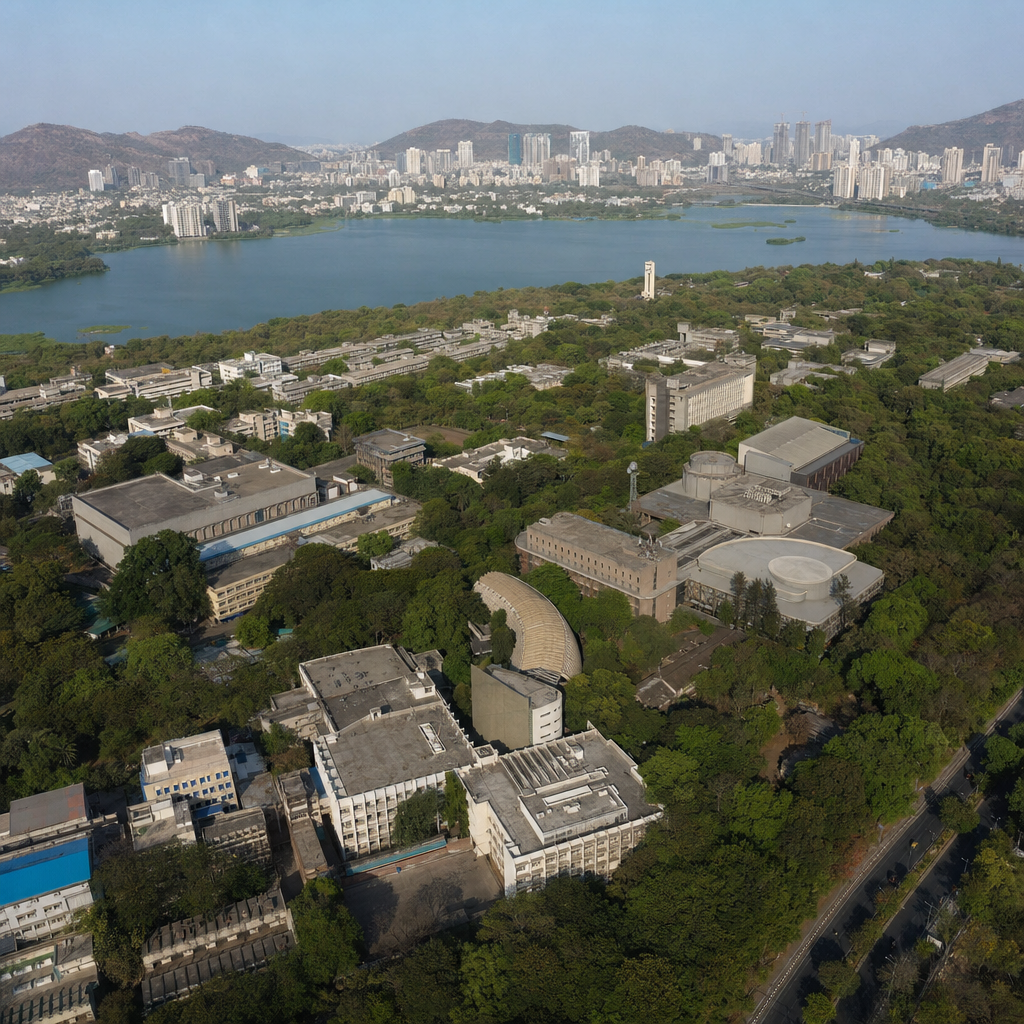
Best Universities in Mumbai for International Students at a Glance
Looking for the top universities in Mumbai for international students? Tuition fees, financial assistance, and visa rules all affect your choice. IIT Bombay and the University of Mumbai lead the city's rankings. IIT Bombay has achieved an overall position of 4 in NIRF 2024 and holds the #3 rank in NIRF Engineering (NIRF). The University of Mumbai ranks in the 101–150 bracket (NIRF) and possesses an A++ NAAC accreditation (NAAC).
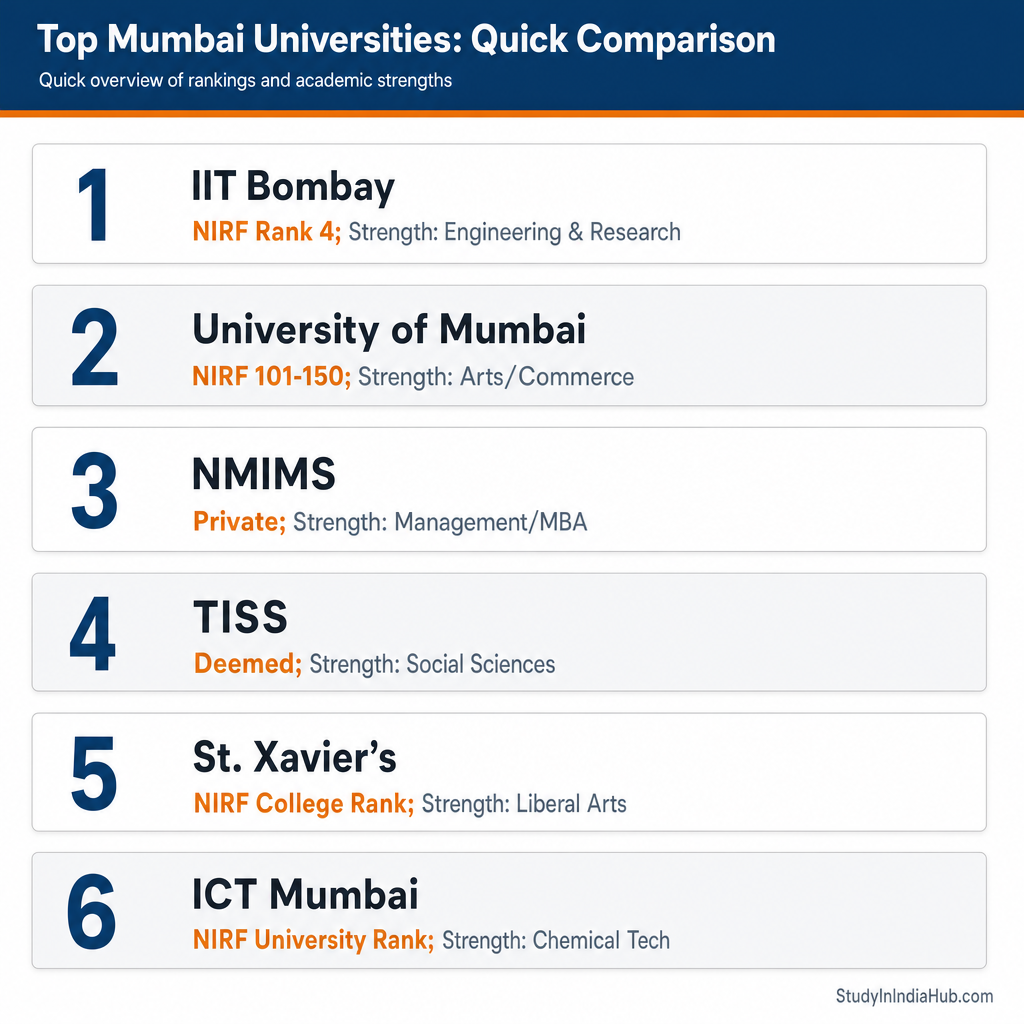
| University | Standout strength | NIRF 2024 rank | Int'l intake / support |
|---|---|---|---|
| IIT Bombay | Engineering & research | 4 (Overall) | 15% supernumerary |
| University of Mumbai | Broad arts/commerce | 101–150 | Department-level support |
| NMIMS | Management/MBA | Private deemed university | Private international desk |
| TISS | Social sciences & policy | Deemed university | 15% supernumerary |
| St. Xavier's College | Arts, commerce, science | NIRF College ranked | 15% supernumerary |
| ICT Mumbai | Chemical technology / STEM | NIRF University ranked | 15% supernumerary |
| SNDT Women's Uni | Women's education | State university | 15% supernumerary |
The amount shown on the website is never the actual cost you'll incur. In Mumbai, the inequality starts with accommodation. Indian institutions cost about 25% of the fees at Western universities (Consulate General of India). For 2026–27, set aside ₹40,000–₹2,50,000 each year for hostel and dining expenses on campus (Study in India). A "low-cost" university can become costly swiftly if you opt for private housing near Powai or South Mumbai. International students might be admitted beyond the approved capacity, up to 15% (ICCR). Leverage the Study in India Portal for e-visas, application processes, and FRRO protocols. You can also apply for the SII Scholarship at that location. It targets learners from Nepal, Bangladesh, and Africa.
How Mumbai's Top Universities Compare
Universities in Mumbai vary significantly. Every one is crafted for a distinct purpose. The title does not convey the entire story. The program assesses your experience. At affiliated universities, it depends on the particular college you choose. An international student should expect to spend roughly $8,500–$10,000 for a full academic year in India (Study in India). Nonetheless, the choice of university affects whether that budget stays restricted or gets expanded.
IIT Bombay
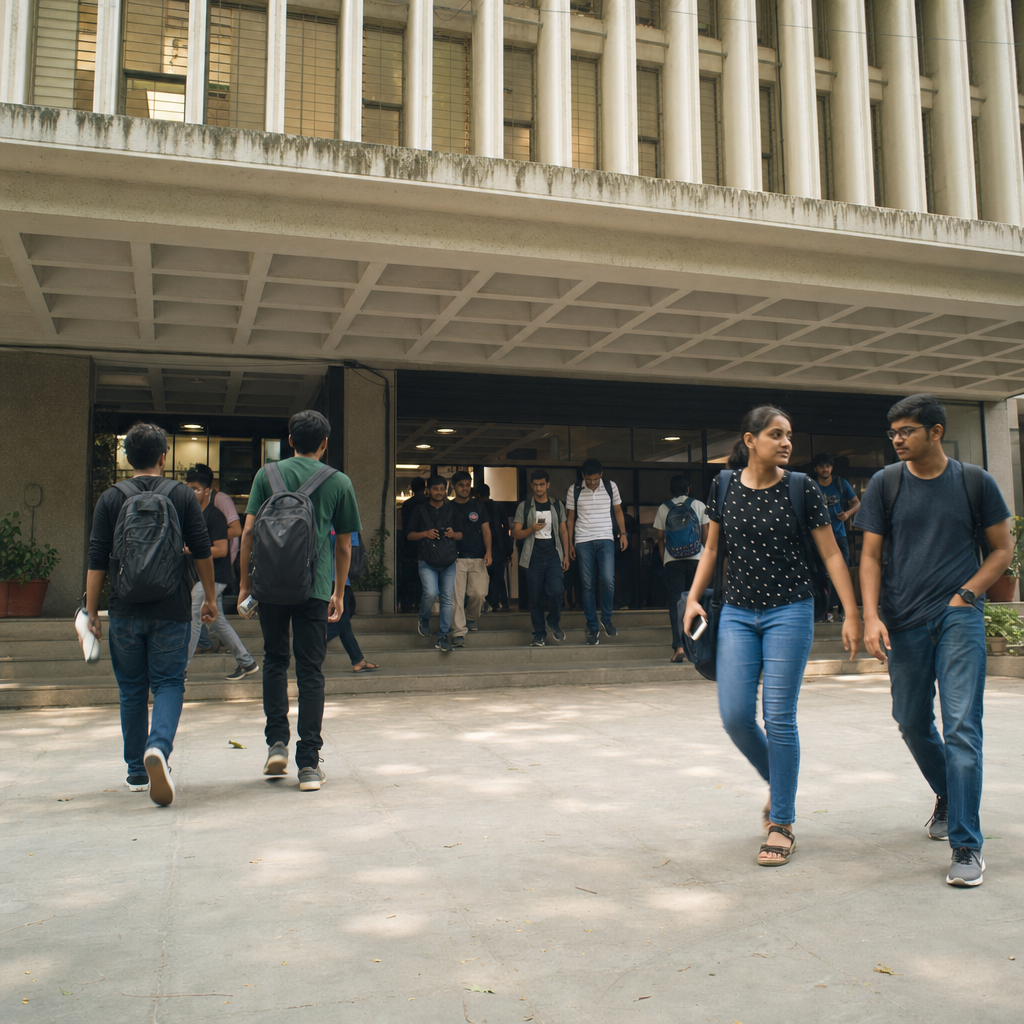 IIT Bombay is positioned at #118 globally (QS). It holds an A++ NAAC grade, the highest certification in India (NAAC). - Focus Areas: Engineering, technology, and natural sciences. - Main programs: B. Tech and M. Tech degrees in Computer Science, Electrical Engineering, and Mechanical Engineering. - For overseas students: Courses are taught in English and meet international criteria for accredited engineering degrees (Puran Murti). You adhere to the same curriculum as residents' students. No watered-down versions. International students typically face expenses of US$2,000–US$4,000 per year for B. Tech (educationdata.org). That is considerably lacking compared to US or UK initiatives. Verify fees with the department directly. The Powai campus operates as an independent town, enabling you to sidestep rental expenses in South Mumbai. - Placement: In 2024–25, 81.79% of B. Tech graduates found employment, up from 75% in 2024. The average package was ₹26.45 LPA, while the median was ₹20 LPA (IIT Bombay Placements). Computer Science attained 92% placement, median ₹28 LPA. - The disadvantage: Admission is highly competitive. Tuition costs vary between ₹6–14 lakh for the complete 4-year program (Retirewise).
University of Mumbai
Established in 1857, this is the leading public university in Maharashtra. It functions as a major affiliating body that includes many colleges (University of Mumbai). It ranks 601–650 globally (QS) and has an A++ NAAC accreditation (NAAC). - Focus areas: Business, humanities, sciences, law, technology, and healthcare across a broad university network. - Main programs: Bachelor of Commerce (B. Com) and Master of Management Studies (MMS). - For international students: This represents the most affordable choice. Nonetheless, your regular education occurs at an assigned partner college. Several are exceptional. Some are not. The cutoff date for enrolling in July usually occurs on April 15. Postpone it by a day and you lose the entire year. To obtain an MBA, you need to possess a recognized university degree in any discipline with at least 60% overall scores. Course durations are established: B. Tech/Engineering 4 years, Law/Architecture 5 years, MBBS 5.5 years. Your institution is validated through the WHED database, which tracks higher education in over 180 countries. - The downside: Absence of a unified campus. Distribute financial resources for travel among college campuses across the city.
NMIMS
NMIMS is a leading private deemed university, specializing in management and business education. It is often ranked among the top MBA schools in India alongside the IIMs (LPU). It encompasses engineering, pharmacy, law, and business.- Focus: Administration, pharmaceutical studies, and engineering.- Main programs: MBA and BBA.- For foreign students: It runs specialized international programs and semester-exchange partnerships abroad (GIMS). The comprehensive MBA fee ranges from ₹17–23 lakhs for the entire program (LPU), not including hostel, visa, and travel expenses. Graduates generally receive ₹15–28 LPA, enabling you to recover your investment within 18–24 months. Leading finance roles receive ₹50–70 lakh (IIDT Escala). Information from GMAC shows that 85–95% of MBA graduates from top institutions find jobs within three months (MBA Exchange). Students have merged institutional merit scholarships with external funding sources. This lowers personal expenses by 30–40%. Nonetheless, it's important to apply early with strong academic qualifications. - The twist: Costs for programs and accommodation are not mentioned on the primary website. Contact admissions to verify your numbers prior to making a decision.
Tata Institute of Social Sciences (TISS)
TISS is India's premier institution for social work, development studies, human resource management, and public policy. It's an established university that emphasizes hands-on education. Its position is most robust in the NGO, CSR, and development sectors. Graduates occupy important roles within organizations and research institutions. - Focus: Community service, workforce management, health systems, and public policy. - Major programs: Master's in Human Resources Management and Labor Relations. - For international students: An office provides assistance with necessary FRRO registration. Confirm that your 10+2 aggregate of ≥50% in relevant subjects is ready for verification (NCHM). Programs include mandatory fieldwork and internships in rural regions. Distribute finances separately for travel, lodging, and research costs that aren't predetermined. - The drawback: It's customized. Not relevant for engineering, medicine, or general undergraduate programs. Details regarding fees, deadlines, and scholarships are not consolidated. A message sent straight to the international admissions office gives you accurate numbers faster than any article.
St. Xavier's College and ICT
St. Xavier's College and the Institute of Chemical Technology (ICT), formerly referred to as UDCT, are two separate options. Xavier's is an autonomous liberal arts/science college, holding an A+ NAAC grade and achieving independent status since 2010. It ranks among the top arts and science colleges in the NIRF rankings. ICT is the top selection for specialized chemical and associated sciences, accredited A++ by NAAC (NAAC) and listed in NIRF University and Pharmacy rankings, providing strong research and semester-exchange possibilities. For you, that distinction holds greater significance than brand labels. The main concern is whether the department corresponds with your area. - ICT focus: Chemical engineering, polymer science, and pharmaceutical technology. The main programs are B. Chem. B. Tech and Engineering in Food Technology. Public tuition remains budget-friendly, but lab fees raise expenses by ₹20,000–₹40,000 each year. - Both support small but growing international communities. ICT draws exchange and research students from Africa and Southeast Asia via bilateral agreements. Verify the current enrollment statistics with all international relations offices, as numbers vary each year. - Undergraduate application timelines can commence as early as October, with entrance exams starting in December for specific courses (College Board). - For loans, make certain that your offer originates from a UGC/AICTE/Govt-recognized institution (Auxilo). - For 2025–26, Nepali students still need to obtain FRRO registration despite open-border policies.
Tuition Fees and Cost of Studying in Mumbai
Let me explain the true cost. The number allocated to the website is never final. You start with a variety of fees. Subsequently, you add accommodation, food, and regional transit as well. Tuition costs vary by institution type. For public universities like the University of Mumbai, international students typically face ₹2–5 lakh per year for engineering or science programs (Leap Scholar). Private colleges frequently charge elevated fees, usually ₹8–15 lakh each year for courses like MBAs. They function without government financial assistance (LPU). The key point is this: in public colleges, international students often pay identical tuition fees as domestic students, instead of a higher fee. This is a major advantage of seeking education in India.
Living Costs in Mumbai
 Prepare for ₹27,500–53,000 every month, depending on your choices. Housing options vary from a shared apartment in Andheri or Powai to a private studio. Halal food can be found at many places along Mohammad Ali Road and Bhendi Bazaar (University of Mumbai).
| Cost Category | Monthly Range (₹) | Annual (₹) |
|---|---|---|
| Accommodation (shared) | 15,000–30,000 | 1,80,000–3,60,000 |
| Food (self-catering) | 8,000–15,000 | 96,000–1,80,000 |
| Transport (trains, autos) | 1,500–3,000 | 18,000–36,000 |
| Utilities & misc. | 3,000–5,000 | 36,000–60,000 |
| Total | 27,500–53,000 | 3,30,000–6,36,000 |
A brief note about leased apartments: treat the deposit and brokerage fees as distinct categories in your financial plan. Campus meal plans usually cost less than eating out, which can result in food expenses surpassing ₹20,000.
Total Cost and Global Comparison
For an engineering course at a state university, expect ₹5–10 lakh each year (including tuition and living costs). For a private MBA, anticipate a budget of ₹15–20 lakh per year. Indian programs cost around 25% of comparable Western programs (India in Atlanta). Compare this with the global undergraduate tuition fees at the University of Glasgow. It ranges from £24,000 to £62,730 for MBChB clinical programs.
| Program type | Mumbai (annual) | Western equivalent |
|---|---|---|
| Public engineering | ₹5–10 lakh | 4× higher (EOI Vilnius) |
| Private MBA | ₹15–20 lakh | Often 3–4× higher |
| Clinical/medical | Varies | £24,000–£62,730 (Glasgow) |
Fees, Waivers, and Hidden Costs
Students overbudget tuition and underbudget the paperwork. Watch for:
- Admission fees: ₹500–2,000 - Hostel security deposits: ₹10,000–20,000 - Visa expenses: S-1 student visa and VFS fees vary based on the nation. Check your specific Indian mission (HCIPOM). Scholarships can greatly lower this cost. Some institutions offer tuition discounts of as much as 40% in major metropolitan areas like Mumbai. UGC allows for 25% more seats for international students. This might affect your fee categorization (UGC).
Scholarships and Financial Support
Scholarships act as the main method to close the gap between the stated price and the real overall amount. The Study in India Scholarship targets individuals from eligible countries. This includes Bangladesh, Nepal, Sri Lanka, UAE, Kuwait, and several African and Middle Eastern nations (ICCR).
Indian Government Schemes (ICCR)
Initially, confirm government support. It's more dependable than inconsistent university discounts, but the duration is restricted. The ICCR Scholarship Programme 2026–27 can be accessed on the A2A Portal from 27 February to 22 April 2026 (ICCR). India offers 120 scholarships each year for students from Sri Lanka, comprising 50 for Master's degrees. Moreover, a separate Indo-Sri Lanka Cultural Exchange Program provides 5 scholarships (HCI Colombo). These generally cover tuition fees and a monthly stipend. Nonetheless, not every course qualifies. Programs in medical fields, paramedical (nursing, physiotherapy, anesthesia), fashion, and law are excluded (Indian Embassy). If your course fits into one of those categories, refrain from devising a plan reliant on ICCR funding that may not receive approval.
University Merit Awards
University honors represent the secondary level. We have noted merit-based scholarships between 10% and 80% at premier MBA schools. The exact figure differs according to the institution and its current policies (CrackVerbal). Award details are not gathered in one place, so verify with each international admissions office individually.
Documentation and Strategy
The granting of a scholarship does not constitute evidence of acceptance. Applications for student visas still necessitate evidence of financial backing along with your acceptance letter. This refers to a scholarship letter, bank statement, or sponsor affidavit (Study in India). The strategy: prioritize applications for government scholarships because of their specific deadlines. Upon receiving an offer, seek university merit-based financial assistance.
Applying as an International Student: Admissions and Visa
 The S-1 student visa in India is available only through the submission of documents. A formal interview is not present (Study in India). As a result, your documentation must be impeccable. A solitary absent stamp leaves your file idle on a desk while the semester starts without you. Here’s the path, one step at a time. International students we've worked with indicate that FRRO registration is the most time-consuming process. Generally, two to three visits are required in the first month. Many graduates from Nepal and Sri Lanka stated that securing the visa was easy after they obtained their admission letter and university verification. Many people reported that their real monthly expenditures in Mumbai were about 10–15% higher than expected, mainly because of off-campus housing expenses. They propose: make a cushion and check hostel availability beforehand.
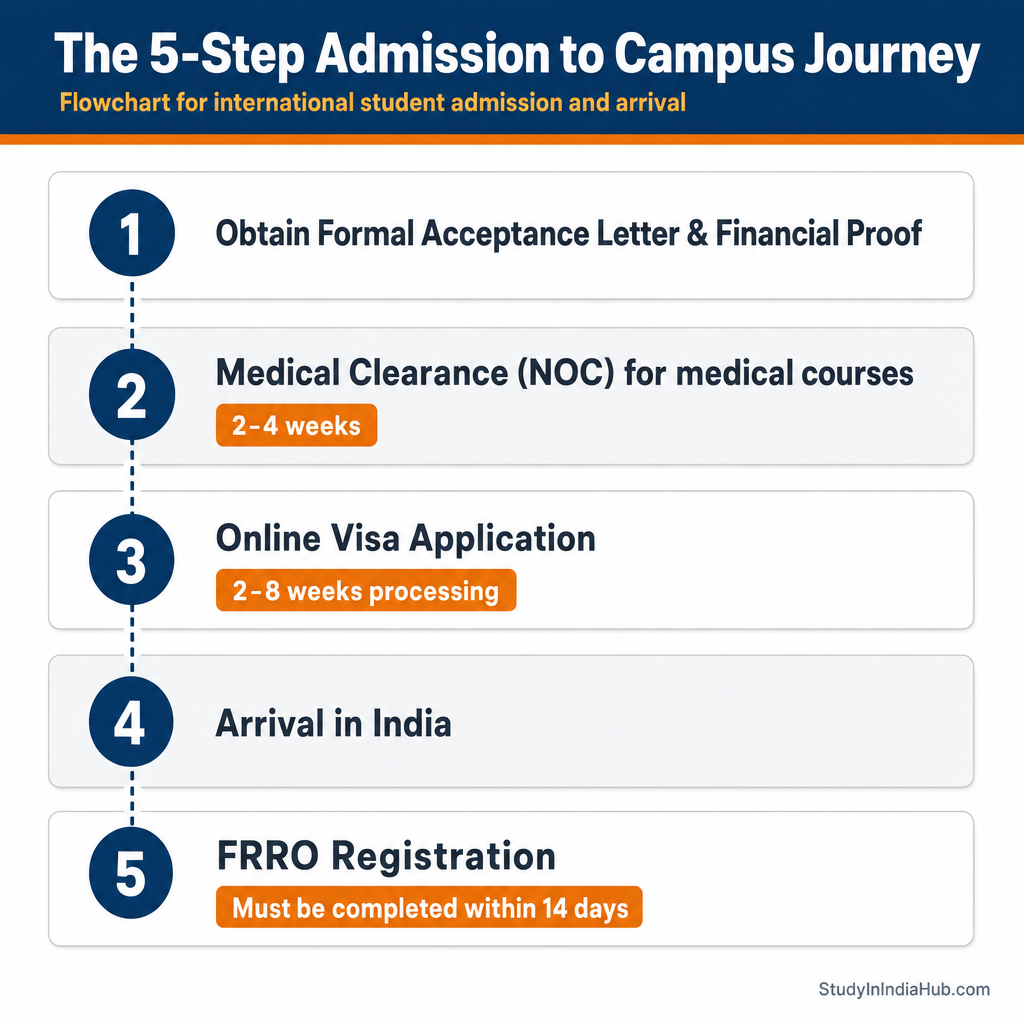
Step 1: Admission Letter and Financial Proof
Your first step is to obtain a formal acceptance letter for a full-time standard program from an accredited institution in Mumbai, in addition to evidence of financial support (Study in India). Financial documentation includes up-to-date bank statements, letters of sponsorship, or scholarship awards that pay for tuition costs and living expenses throughout the entire course duration. What we often see: students rejected because their bank statement is dated three months earlier. The task demands up-to-date proof.
Step 2: Medical Clearance (If Applicable)
Medical or paramedical courses necessitate a No Objection Certificate (NOC) from the Ministry of Health (Study in India). This lengthens your timeline by 2–4 weeks. Most other programs neglect it.
Step 3: Apply for Your Student Visa
Transmit all documents electronically through the Indian Visa Online portal (indianvisaonline.gov.in). It guides you to services like VFS Global based on your location (HCIPOM). Processing may require 2–8 weeks, depending on your location, the thoroughness of your documents, and the seasonal period (IDP). Is there an admission in July or August? Expect the total length of 8 weeks. Enrollment in January? Generally 2–3 weeks. The validity of your visa is linked to the length of the course, rather than a set 5 years.
| Program | Typical Validity |
|---|---|
| Undergraduate | 4 years (IDP) |
| Master's (coursework) | 2 years |
| Research / PhD | 3 years |
| Maximum | 5 years or course duration, whichever is less (Study in India) |
VFS charges and fees vary by country, as determined by Indian missions on the official website (HCIPOM). Check the charges for your own nation. Don't assume they are like a friend's.
Step 4: FRRO Registration Within 14 Days
If your
Common Mistakes to Avoid
These errors lead to weeks of delays for students and sometimes even a whole year. Make sure to fix them before submitting.
Not checking AIU equivalency for your home qualifications
This confounds more students than you may anticipate. Before submitting your application, ensure that the Association of Indian Universities (AIU) assesses your home qualifications. Some degrees and educational certificates do not directly correspond to Indian standards. Address this quickly. A missing equivalency certificate may postpone your admission or visa for several weeks before your start date.
Assuming all programs are taught in English
Do not accept "English-friendly" without question. Many universities in Mumbai provide courses in English. Nonetheless, some courses or electives remain to be taught in Hindi or Marathi. Reach out to the appropriate department directly, rather than just contacting the international office. Ask about the present language used for instruction. Document it to prevent any unexpected events during your initial class.
Other costly errors we see every year
- Submitting bank statements older than six months - Not finalizing FRRO registration within 14 days of arrival - Applying for a course level not qualifying for your intended scholarship - Discrepancies in names between passport and academic records - Providing unverified or untranslated documents Fix these problems prior to submission. It prevents weeks of repeated exchanges with admissions offices.
Frequently Asked Questions
Is a combined 5-year degree like BA LLB or B. Sc + M. Sc sufficient for application?No. Integrated programs like BA LLB (5 years) and B. Sc & M. Sc (5 years) do not qualify under the standard ICCR scholarship rules (ICCR A2A Portal). Students frequently lose their entire funding package by opting for a 5-year dual degree. Think about registering for an independent 3-year Bachelor's or 2-year Master's program instead. This guarantees that you continue to meet the requirements for the stipend and waivers.
Do undergraduates and postgraduates need the same English score?
Not positive. The majority of undergraduate programs ask for IELTS scores ranging from 6.0 to 6.5. Postgraduate and research programs generally demand 7.0 or higher (IMMI Talks). A score 0.5 lower than the requirement may result in the University of Mumbai rejecting your eligibility certificate. The fee for processing is around ₹5,000 to ₹10,000 (University of Mumbai).
How long can I stay after graduation?
Stay-back duration is strictly tiered by course type (IDP):
| Course Type | Stay-Back Duration |
|---|---|
| Bachelor / Masters Coursework | 2 years |
| Masters Research / PhD | 3 years |
Coordinate your visa timeline with the degree type. A taught master's and a research master's don't hold the same value. What is the minimum financial proof needed for the student visa? For courses longer than 8 months, you must show access to €10,000 per year (IDP). Incorporate FRRO registration fees and mandatory health insurance. Students not achieving this balance risk having their visa extension requests denied at the Mumbai FRRO office. For long-term programs, verify the latest statistics prior to finalizing funding. Is there an acknowledgment that students ask about this at the University of Mumbai? Definitely. Perform three checks before paying any application fee: - Official registration at mu.ac.in, established 1857 (University of Mumbai) - A++ NAAC rating, the highest accreditation in India (NAAC) - NIRF 2024 ranking of 101–150 in the overall category (NIRF) The A++ grade is crucial, as many scholarship organizations only assist institutions rated A or higher.
What if my documents are incomplete?
Refrain from submitting a file that is not complete. Check the checklist on the official website mu.ac.in and make copies of your academic documents (University of Mumbai).
What matters more than rankings?
The particular elements: entry requirements, IELTS results, and length of the program. Students sacrifice weeks neglecting course structure in pursuit of ranking (IDP).
About the Author
Arun Menon spent three years overseeing scholarship initiatives at ICCR before joining StudyInIndiaHub.com. He helps international students comprehend tuition costs, living expenses, and financial assistance. He transforms complicated fee structures into clear comparisons and understands the expenses that universities often don't reveal upfront.
How We Researched This Article
Each article is checked against primary sources and evaluated by education specialists with direct experience in international admissions. Our data is obtained from official university sites, NAAC and NIRF databases, government visa websites, Numbeo cost-of-living data, and direct contact with university international departments. Exchange rates for currencies are updated daily. Living expenses updated weekly. Quarterly assessment of university information. Xavier's College, Mumbai possesses an A+ NAAC rating and is recognized as one of the top arts and science colleges in the NIRF College rankings. It has kept its independent status since 2010. In comparison, the Institute of Chemical Technology (ICT) Mumbai holds an A++ rating from NAAC (NAAC) and is listed in the NIRF University and Pharmacy rankings, underscoring its focus on research. Both possess small but growing international teams. ICT draws exchange and research students from Southeast Asia and Africa via bilateral agreements. Verify the current enrollment figures with each international relations office, as these numbers vary every year.
Sources
- NIRF Overall Ranking 2024
- NIRF Engineering Ranking 2024
- NAAC Accreditation Results
- QS World University Rankings 2025
- Consulate General of India
- Study in India
- ICCR
- Study in India Portal
- Puran Murti
- educationdata.org
- IIT Bombay Placements
- Retirewise
- University of Mumbai
- LPU Blog
- GIMS
- [IIDT Escala