Engineering in India for Gulf Students (UAE/Kuwait): Fees in AED, Admission 2026
Written by Arun Menon, Specialist in Education Finance | Latest update: June 10, 2026
Engineering in India for Gulf Students: The Quick Picture
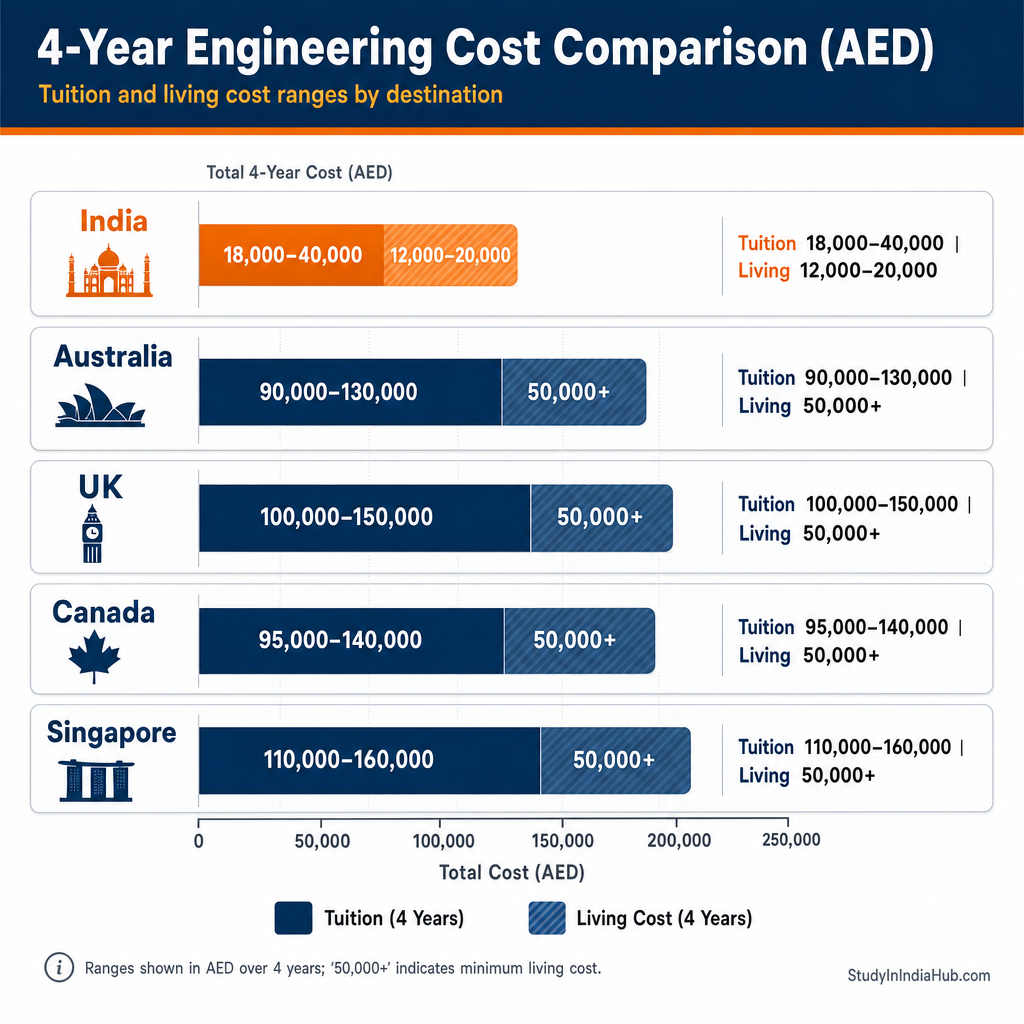
Indeed, India is a viable option for UAE and Kuwait students seeking a B. Tech or B. E. The yearly tuition costs roughly one-fourth of similar Western programs (Embassy of India, Kuwait). The disparity becomes evident when you combine tuition and living expenses for 2025–26.
| Destination | Annual tuition (AED) | Annual living costs (AED) |
|---|---|---|
| India | 18,000–40,000 (Study in India Portal) | 12,000–20,000 (Numbeo) |
| Australia | 90,000–130,000 (Study Australia) | 50,000+ (Numbeo) |
| UK | 100,000–150,000 (UCAS) | 50,000+ (Numbeo) |
| Canada | 95,000–140,000 (Statistics Canada) | 50,000+ (Numbeo) |
| Singapore | 110,000–160,000 | 50,000+ |
[IMAGE PLACEHOLDER: Bar chart comparing 4-year total cost of an engineering degree across India, Australia, UK, Canada, and Singapore in AED.]
For a four-year degree, India can help a Gulf family save AED 300,000 or greater. These are representative ranges from available fee schedules and typical cost estimates. Check every figure against the institution's 2026 admission notice. Tuition fees at central universities range from ₹2–5 lakh annually. This places the total cost of a four-year degree at IITs and NITs between ₹6–14 lakh. Include living expenses of ₹15,000–₹30,000 each month. A complete year consequently amounts to approximately USD 8,500–10,000 (AED 31,200–36,700) (Numbeo). For 2026, there are three ways to gain admission: DASA, NRI quota, and direct merit application. The majority of Gulf students utilize DASA or NRI. Both bypass JEE Main. Your visa requires evidence of ₹10 lakh in funds (Study in India Portal). Begin board equivalency preparations early for the 2026 intake.
Fees in AED and KWD: What You'll Actually Pay
The figure on a university website is never the ultimate amount on your bank statement. Students from Dubai and Kuwait City frequently find themselves caught off guard by the "NRI/International" fees. It operates significantly higher than what local Indian students are charged. Your fees vary based on the level you aim for. The range is extensive.
Tuition: The Three Tiers
- Central government universities (NIT/IIIT through DASA): approximately ₹2–5 lakh annually for engineering. DASA fees are higher than local rates yet remain fair. To provide context, undergraduate programs at Delhi University cost only ₹10,000–₹25,000 per year (NAAC Accreditation Results).- Private recognized universities (BITS Pilani, Symbiosis, VIT): ₹3–15 lakh annually.- State and mid-tier private engineering institutions: ₹50,000–₹2,00,000 and ₹80,000–₹3,00,000 per year.
Converting to AED and KWD
| University Tier | Annual Tuition (INR) | AED | KWD |
|---|---|---|---|
| Central University (DASA) | ₹2–5 lakh | 4,400–11,000 | 1,680–4,200 |
| Private Deemed | ₹3–15 lakh | 6,600–33,000 | 2,520–12,600 |
| Govt. Engineering College | ₹50,000–₹2,00,000 | 1,100–4,400 | 420–1,680 |
| Private Engineering College | ₹80,000–₹3,00,000 | 1,760–6,600 | 672–2,520 |
Hostel and Mess: The Hidden Second Bill
Tuition represents just a part of the overall picture. Here is where students make errors in their calculations. Hostel and cafeteria charges are nearly always invoiced separately.- The hostel and dining facilities on campus for 2026–27 usually cost ₹40,000–₹2,50,000 per year.- BITS Pilani: ₹36,000 each semester (approximately ₹72,000 annually).- Chanakya University: a triple room costs ₹1,42,000 and a double room ₹1,84,000 per year. That's AED 880–5,500 (KWD 336–2,100) annually just for the hostel. Include it directly in tuition fees. Don't consider it as non-essential. Costs of living in India continue to surpass the other options. You will approximately pay 300 USD each month (Numbeo) compared to 1,400 AUD monthly in Australia (Numbeo).
DASA vs. NRI Quota: Why the Fees Differ
Via DASA, the typical path for most Gulf students: you will be charged DASA fees. They exceed local charges but are less than comprehensive NRI prices. Standard DASA engineering metrics are not distributed uniformly among universities. Confirm directly with every international admissions office. NRI-quota seats have varying charges. They frequently operate ₹2,00,000–₹5,00,000 annually at central universities. You must fulfill specific requirements to gain access to them. At Panjab University, NRI classification adheres to the Income Tax Act, 1961. Verify if your intended university employs a SAARC vs. Non-SAARC framework. The Central University of Himachal Pradesh offers lower SAARC rates, reaching as low as ₹2,000 in a specific category (Study in India Portal). Holding a SAARC passport while residing in the UAE can save you thousands of Dirhams through that quota. A remark regarding leading research institutions. At IISc Bangalore, individuals of Indian descent with foreign passports are required to apply via the standard Indian-citizen procedure if they possess an Overseas Citizenship of India according to Section 7B(1) of the Citizenship Act, 1955.
Living Costs in Indian Engineering Cities
Monthly living expenses in India's engineering centers are divided into three categories: budget, moderate, and comfortable. The level is determined by your housing selection. You can share a room in a hostel, rent independently, or reside in a high-end neighborhood. Numerous families focus on tuition and then are caught off guard by rent, chaos, and transportation. Develop the strategy starting with monthly living expenses, then focus on tuition.
| City | Budget/month | Moderate/month | Comfortable/month |
|---|---|---|---|
| Bengaluru | ₹15,000 | ₹25,000 | ₹42,000 |
| Mumbai | ₹15,000 | ₹25,000 | ₹40,000 |
| Pune | ₹12,000 | ₹20,000 | ₹32,000 |
| Delhi | ₹14,000 | ₹23,000 | ₹38,000 |
Sources: Bengaluru, Mumbai, Pune, Delhi
Pune is the most affordable. Mumbai becomes expensive as you transition from basic to cozy. Bengaluru's tech hubs increase rental prices. A ₹10,000/month urban discrepancy translates to ₹1,20,000/year**. Approach the selection of a city as a financial choice, rather than merely an academic one.
What "moderate" actually includes
- Dormitory or PG accommodation: ₹6,000–₹10,000- Canteen or self-cooking: ₹3,000–₹5,000- Local transportation (metro or bus fare): ₹1,000–₹1,500- Mobile plan: ₹299/month offering 1GB of daily data and unlimited voice calls- Books, laundry, excursions: ₹2,000–₹3,000
Convert to AED for annual budgeting
At present prices, average monthly expenses amount to roughly AED 800–900 in Pune. They cost AED 900–1,100 in Bengaluru, Mumbai, and Delhi. The guideline: monthly expense multiplied by 12, adding a 15–20% cushion for travel or healthcare expenses.
| City | Annual moderate | +15% buffer | +20% buffer |
|---|---|---|---|
| Bengaluru | ₹3,00,000 | ₹3,45,000 | ₹3,60,000 |
| Mumbai | ₹3,00,000 | ₹3,45,000 | ₹3,60,000 |
| Pune | ₹2,40,000 | ₹2,76,000 | ₹2,88,000 |
| Delhi | ₹2,76,000 | ₹3,17,400 | ₹3,31,200 |
CBSE, IB and Other School Boards: Equivalency for Admission
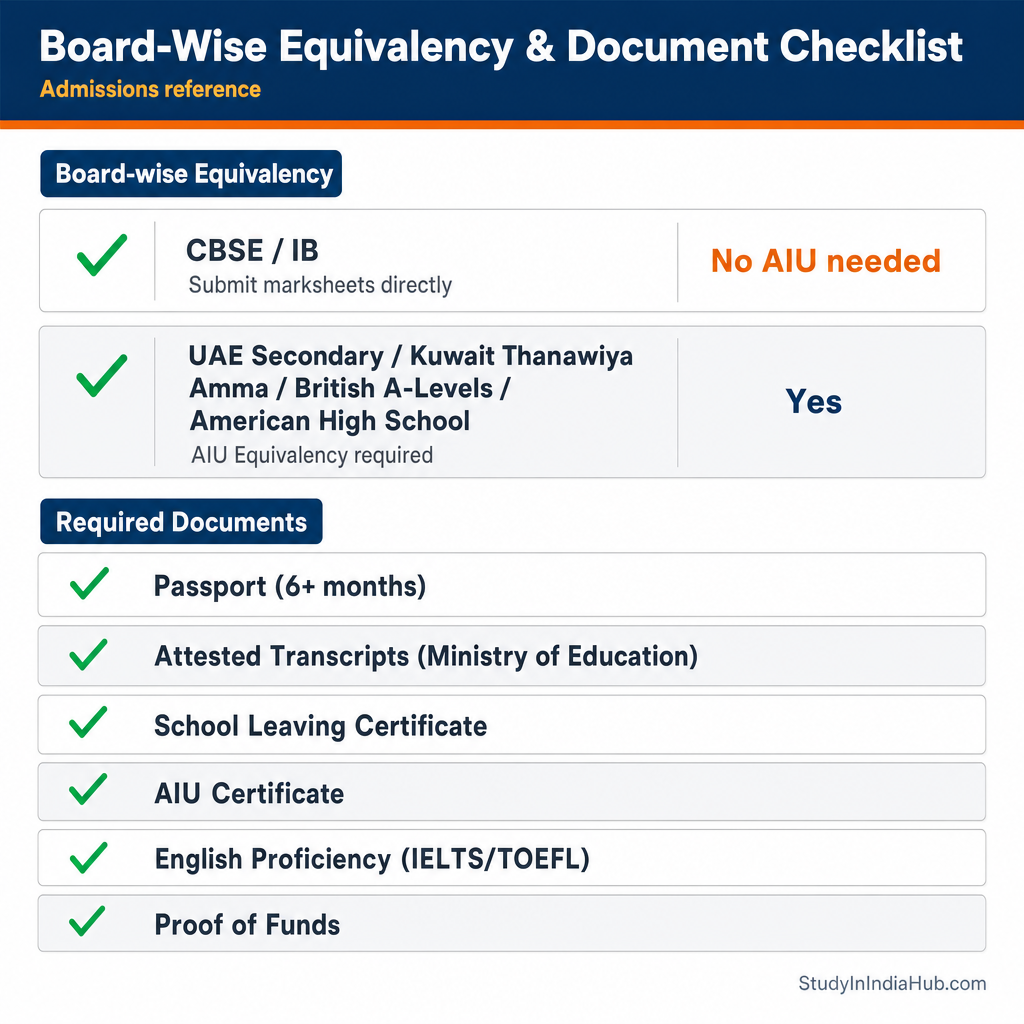
If your Gulf school adheres to CBSE or IB, your primary responsibility is ensuring document precision. If it adheres to British, American, UAE Ministry of Education, or another authority, your role is scheduling. You must obtain an Equivalency Certificate from the Association of Indian Universities (AIU) prior to most engineering colleges processing your application (AIU Equivalence Division). An absence of equivalency can halt an application despite strong grades. The AIU certificate typically requires four to six weeks after you provide a complete file. The primary causes for delays are absent attestations, transcripts lacking subject-wise marks, and documents submitted prior to the final Grade 12 results. Students who validate documents early, prior to the May and June peak: establish equivalence well in advance of cut-off dates.
What gets recognized, and what needs AIU
The UAE includes CBSE, IB, British, and American as part of its standard curricula. This is the reason Indian colleges frequently encounter these transcripts.
| School board | Equivalency required? | What to do |
|---|---|---|
| CBSE | No — accepted directly | Submit marksheets, check subject eligibility |
| IB | No — accepted directly | Keep final transcript ready |
| UAE Secondary Certificate | Recognized | Verify university-specific document format |
| Kuwait Thanawiya Amma | Yes (AIU) | Apply early — submit transcripts |
| British (A-Levels) | Yes (AIU) | Don't submit as "directly eligible" |
| American High School | Yes (AIU) | AIU converts letter grades to a percentage |
Source: AIU Equivalence Division
How the AIU process works
You provide transcripts, mark sheets, and curriculum information to the Evaluation and Equivalence Division of the AIU. It evaluates your board's criteria against the Indian 12th and provides a certificate. The stated timelines range from 5 to 11 business days. Expect around 15 days during the peak in June–July. Complete processing may take 2 to 6 weeks (AIU Equivalence Division). A student from Kuwait missed her July intake as the certificate took 11 days instead of the expected 5. That caused her to miss the enrollment deadline. Many universities impose a minor fee, usually ₹500–₹2,000. Verify the existing number with AIU initially.
Minimum marks
Engineering eligibility relies on the 10+2 framework: Physics, Chemistry, Mathematics (or Biology), English, and a minimum of 50% aggregate in essential science subjects (40% for some reserved categories) (AIU Equivalence Division). Numerous students focus on the overall percentage and overlook the subject combination. A marksheet with discrepancies is disqualified prior to the merit phase.
Why timing matters
Obtain the equivalency prior to applying, not post-admission. The college requires this certificate during document verification through the DASA or NRI quota. It is also necessary for your student visa, which requires validated academic documents and a Confirmed Admission Letter. Visa processing requires at least 5 to 15 business days (Study in India Onboarding & FRRO). At major hubs such as SPPU, 14,000 international students from over 102 countries: awaiting paperwork occupy seats (SPPU International Centre). Submit your equivalency application approximately three months in advance.
Admission Routes for 2026: DASA, NRI Quota and Direct Application
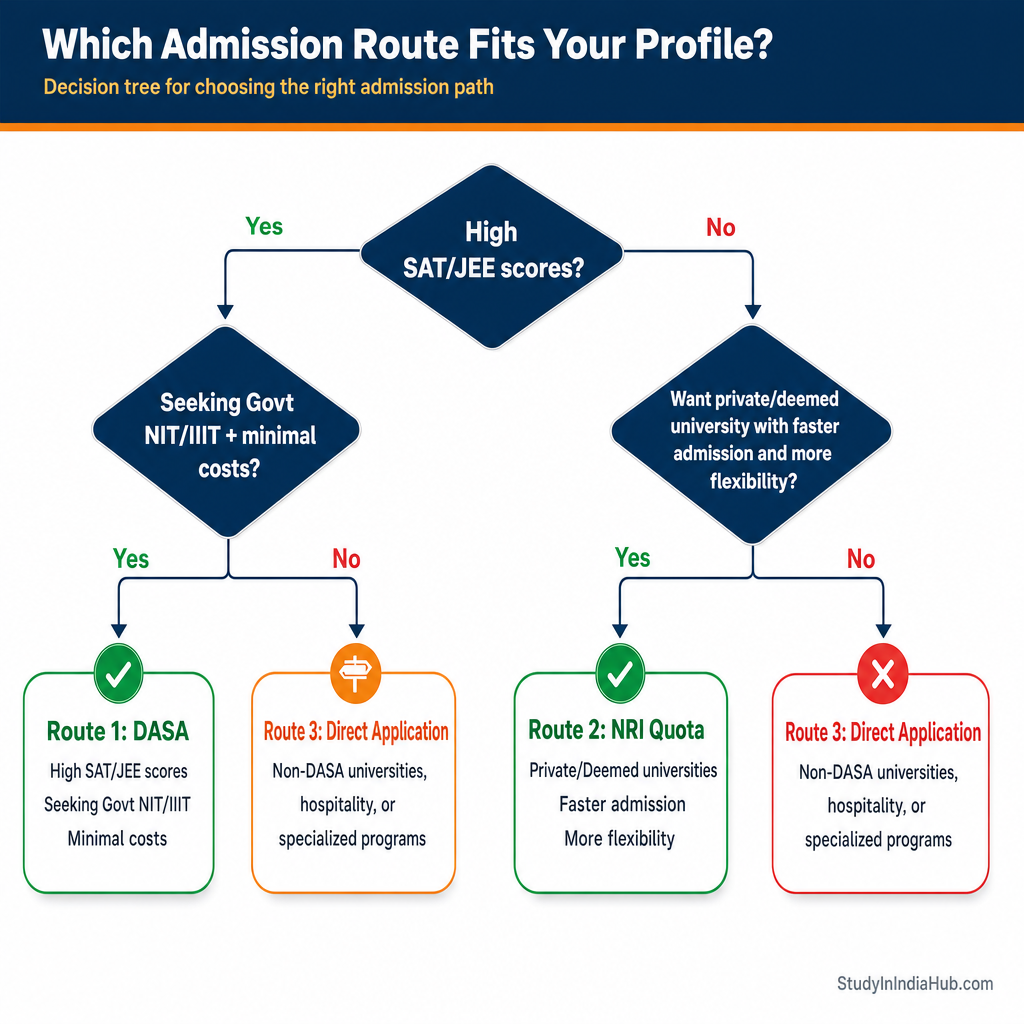
Having your equivalency ready, the subsequent choice is which path suits your case. Gulf students have three options for 2026: the DASA scheme for government technical institutions, the NRI/Foreign Quota in private and deemed universities, and direct application. Evaluate all three in rupees prior to making a decision.
DASA: The SAT/JEE Route for NITs, IIITs, and CFTIs
DASA (Direct Admission of Students Abroad) provides the quickest pathway to premier engineering institutions in India, NITs, IIITs, and CFTIs (DASA). You aren't competing within the overall JEE pool. You provide a SAT or JEE Main score obtained outside India, along with your school equivalency records and passport. These institutions receive government support, ensuring that fees remain lower than those of private universities, usually ₹1–3 lakh annually. The key factor is timing. DASA cycles operate independently of the main JEE counselling. A DASA PG 2026 cycle has been confirmed, but a complete schedule with dates has not been released yet. Monitor dates with all involved institutions.
NRI/Foreign Quota: Private and Deemed Universities
This is the path that many Gulf students follow, and expenses differ greatly. Private and deemed universities are permitted to enroll foreign nationals and NRIs beyond their standard intake, up to 15% of authorized capacity.
| University | Route | Annual NRI Fee (2026–27) |
|---|---|---|
| Ashoka University, Sonipat | NRI Quota | ₹10–12 lakh (same across categories) |
| Christ Deemed University, Bengaluru | NRI Quota | ₹2–6 lakh |
| Nirma University (BBA-MBA) | NRI Quota | US$6,650 |
Two "NRI seats" can vary significantly in price, excluding hostel deposits and additional fees. If you hail from Bangladesh, Nepal, or Sri Lanka, verify if your university acknowledges SAARC quota advantages. Jamia Millia Islamia provides a US$500 discount on the admission fee for supernumerary foreign/NRI applicants from SAARC nations (Study in India Portal).
Direct Application: Hospitality and Specialized Programs
For hospitality or culinary courses, you submit your application directly to organizations such as NCHMCT. The disclosed framework indicates an institutional fee of USD 5,400 annually along with an NCHMCT fee of USD 600 per annum. Families plan for tuition, only to be surprised by an additional body fee. If your college expenses are in dollars, your payment in rupees fluctuates with the exchange rate. Direct application includes universities not part of DASA and NRI schemes. Processing takes 2–3 weeks in certain institutions, while at others it lasts 6–8 weeks.
Scholarship Overlap and Deadlines
You can pair an NRI admission with an ICCR A2A scholarship to significantly reduce fees. The ICCR initiative for 2026–27 is available from 27 February to 22 April 2026 (ICCR). Ayush (traditional medicine) applications generally end on 15 May 2026. Students who begin seeking funding in May miss this opportunity.
Which Route Fits Your File
- Impressive SAT/JEE scores, seeking minimal costs and a government qualification? Begin with DASA.- Desire quicker private admissions and more flexibility? Choose NRI quota.- Applying to a non-DASA university or hospitality? Submit your application directly.
Step-by-Step: Applying from the UAE or Kuwait
The procedure from the Gulf is simpler than many students anticipate. However, the timing is unyielding. Fail to meet one deadline and you move to the next enrollment period. Gulf families frequently plan their budgets carefully for tuition yet overlook the associated expenses. Students utilizing the DASA pathway in 2025–26 considered the USD 8,000 SAARC/non-SAARC fee reasonable. The unexpected costs arose from hostel deposits, compulsory medical insurance, and the difference between paying the seat-acceptance fee and receiving the final allotment. The schedule also extends beyond what was anticipated. Numerous applicants who began document attestation in May continued to complete the apostille and equivalence processes through July. Incorporate a 6–8 week buffer prior to counselling to prevent last-minute pressure.
Step 1: Register on the Portal
For the 2026–27 ICCR A2A route, the portal launched on 27 February 2026. One official announcement states the closing date as 15 April 2026, while another states 22 April 2026. Consider the earlier date as the secure deadline and confirm the most recent number on the portal (ICCR). The majority of university portals will be accessible in January–February 2026. Set up your account in advance to avoid longer wait times.
Step 2: Sort the Entrance Test
Numerous engineering courses necessitate JEE Main, which took the place of AIEEE in 2013. Certain universities either accept SAT scores or grant admission without requiring an exam. Verify on your chosen university's website prior to studying for exams. HSC board results are significant in the JEE Main evaluation, so they aren't just trivial documents.
Step 3: Get the Equivalency Certificate Early
This is where Gulf candidates frequently get stuck. Academic qualifications like the UAE Secondary School Certificate, CBSE, IB, or Kuwait's Thanawiya Amma need to be assessed by the AIU Equivalence Division. Consider postal delays from the Gulf. Begin 8–10 weeks prior to your deadline (AIU Equivalence Division).
Documents checklist:
| Document | Notes |
|---|---|
| Passport | Valid 6+ months beyond intended stay |
| Attested transcripts/mark sheets | All years, attested by school or UAE/Kuwait Ministry of Education |
| School leaving certificate | Original or attested copy |
| AIU equivalency certificate | Once received |
| English proficiency | IELTS/TOEFL, or medium-of-instruction exemption letter |
| Proof of financial support | Bank statements covering tuition + living costs |
Attestation details: Certificates need to be certified by your school's principal or the Ministry of Education in UAE/Kuwait. A notary public certification alone is insufficient. An unverified transcript halts the file during the initial review. IELTS on Computer scores arrive within 1–5 days, so allow some leeway near a deadline.
Step 4: Submit and Track
After equivalency and attested documents are prepared, upload all of them onto the portal. The majority of universities have a unified March–April 2026 deadline for the July enrollment. Results will be available in April–May.
Step 5: Visa and e-FRRO
The Indian student visa (S-1 category) is based on documentation, no interview. Processing takes 7–10 business days for Kuwait (Embassy of India, Kuwait) and 5–7 days for the UAE (Consulate General of India, Dubai). Upon arrival, complete registration with e-FRRO within 14 days. Not having it results in a penalty of nearly USD 30.
Scholarships and Fee Concessions Worth Knowing
The students who manage to reduce their engineering fees utilize multiple funding sources. They don't rely on a single strategy.
ICCR A2A Scholarship — The Most Direct Route
If you hail from the UAE, Kuwait, Bangladesh, Sri Lanka, Nepal, Africa, or the Middle East, the ICCR Africa/Asia (A2A) program is the primary government-supported choice. It includes tuition for central and state universities affiliated with ICCR (ICCR). While exact tuition coverage details aren't disclosed, students generally experience 60–80% of yearly fees covered based on the university level and their academic standing. The competition is intense: approximately 4,000 Sri Lankan applicants vied for 200 fully funded scholarships in 2026–27 (ICCR). All payments are now processed through PFMS starting February 2021, via direct bank transfer, so ensure your bank and document record remains clear.
Other Schemes Worth Stacking
| Funding route | What it is | Key detail |
|---|---|---|
| Atal Bihari Vajpayee General Scholarship | Broader ICCR stream, not country-specific | 640 slots; offer letters by June 15, 2025 |
| Sushma Swaraj Silver Jubilee Scheme | ICCR stream | 100 slots in 2022–23 |
| SAARC Quota / Fee Concession | University-level fee cut, not a full scholarship | Many central universities cut 10–25% of tuition; confirm with admissions |
| CIHM tuition waiver | Hospitality institutes in Delhi, Mumbai | Up to 40% tuition waiver |
Source: ICCR
The Real Move
Merit awards based on SAT scores and those specifically for NRIs are not available in a standardized format. Every organization establishes its own standards. Reach out to the international student office directly. A Bangladeshi student combined an ICCR award with an institutional merit waiver to significantly reduce overall fees.
Studying in Mumbai and Beyond: Industry and Placement Outlook
Investing in Mumbai is worthwhile when the degree results in a definitive placement pathway. The name of the city is not the reward. The crucial inquiry is if the campus offers recruiter access, internship timelines, and a placement history that validates the cost.
[IMAGE PLACEHOLDER: Map of India highlighting Mumbai, Pune, and Bengaluru engineering hubs with average placement packages.]
Placement statistics from the 2024–25 cycle indicate significant ROI for Gulf students.
| Institute | Package (INR) | Approx. AED / USD | Top recruiters |
|---|---|---|---|
| BITS Pilani | Median ~19.5 LPA | AED 86,000 / USD 23,400 | Microsoft, Amazon, Goldman Sachs |
| NIT Trichy | Average ~16 LPA | AED 70,000 / USD 19,200 | L&T, Tata, Qualcomm |
These numbers are derived from the official placement reports of each institute. They propose that engineering graduates can recoup their expenses within a few years of employment.
| Institution | 2023 Placement Rate | Average CTC (INR) | Average CTC (USD) |
|---|---|---|---|
| IIM Calcutta | 100% | 35,07,000 | $42,750 |
| IIM Kozhikode | 100% | 31,02,000 | $37,813 |
| IIM Indore | 100% | 30,21,000 | $36,825 |
Source: GMAC
Nationally, 82% of students who participated in the 2022–23 placement season secured placements. For Gulf students, Mumbai and Pune bridge the divide between academics and the workforce. A brief flight along with a city internship develops experience in India. The profile subsequently returns to Dubai, Abu Dhabi, or Kuwait, presenting a more coherent narrative for employers. A Sharjah → Mumbai one-way ticket costs approximately USD 60, making trips back for interviews or family gatherings manageable. As a member of the 72,000+ international students in India, you gain alumni connections that extend from Mumbai's financial hub to the tech parks in Bengaluru. A qualification from the globe's second-largest higher education system, consisting of more than 800 universities, provides the abundance of case studies and hands-on experience that Gulf employers appreciate. For MBBS hopefuls, the 1-year compulsory internship within the 5.5-year program serves as a direct link to practical clinical experience. One document reminder: the Study in India (SII) platform was launched on 3 August 2023, operated by the MoE, MEA, and MHA. Students attending full-time are required to enroll on it.
Your 2026 Action Plan and Common Mistakes to Avoid
Begin 6–8 weeks prior to your intake. That window shields you from the two setbacks that impact Gulf applicants the hardest: equivalency documentation and quota timelines. The most expensive error is turning in unverified transcripts. Indian universities frequently dismiss documents that do not have attestation from the Indian Embassy or the Ministry of Foreign Affairs in the UAE or Kuwait. This may postpone admission by several weeks. Certain students mix up the DASA application deadline with JEE Main exam dates, causing them to miss the opportunity for the NRI quota. Some neglect FRRO registration upon arrival. Not registering within 180 days may lead to fines and visa issues. Numerous families plan their budget solely for tuition in AED and overlook the single-time hostel, caution deposit, and development fees that increase the expenses of the first year.ICCR A2A scholarships for 2026–27 will be available from 27 February to 22 April 2026, with selections by Indian Mission/Post continuing until 31 May 2026 (ICCR). If you overlook the 15 May 2026 Ayush deadline, you forfeit a year of funding. Your final admission cannot be processed at universities such as Savitribai Phule Pune University without an AIU Equivalence Certificate, which issued its 2026–27 notification on 4 March 2026. If you come from a Gulf board that is not CBSE/IB, file this first. Utilize your personal email address for all portal correspondence.
| Action Item | Deadline / Lead Time | Why It Matters |
|---|---|---|
| AIU Equivalence | ~15 days upload | No admission without it |
| ICCR A2A Portal | Feb 27 – Apr 22, 2026 | Missing it closes scholarship doors |
| Visa (UAE / Kuwait) | 5–7 / 7–10 working days | Avoid missing orientation |
| FRRO Registration | Within 14 days of arrival | Mandatory for visas >180 days; late fee otherwise |
FRRO registration is no cost if submitted punctually (Study in India Onboarding & FRRO).
Common Mistakes to Avoid
Gulf families meticulously organize every dirham, yet often find themselves surprised by the same recurring issues. Here’s what to view.Excluding the security deposit. The majority of colleges require a refundable deposit in addition to tuition, typically ranging from ₹25,000 to ₹50,000. Families plan for the costs but overlook this portion due at enrollment. Have it prepared in your initial transfer.Assuming hostel is confirmed. A college slot does not equate to a hostel bed. Spaces get taken quickly, usually on a first-come basis. Submit your hostel application as soon as your admission is verified. Hold on, and you could find yourself searching for private rooms in a strange city.Undervaluing expenses in places beyond Mumbai and Pune. Do not think that smaller cities are consistently inexpensive. While rent might be cheaper, expenses for food, transportation, and supplies still accumulate. Create a practical monthly budget for each city you are considering. A sudden gap in the middle of the semester is difficult to address from the Gulf.Failing to submit scholarship applications before the deadline. Scholarships have strict cutoff dates that seldom change. Numerous students believe they can submit their applications post-admission, but that opportunity has already ended. Verify eligibility and apply early, even prior to finalizing your seat.
Frequently Asked Questions
Is it possible to use several scholarships to pay for a larger portion of my expenses?Occasionally, though not as most students believe. The majority of Indian universities allow you to combine a government scholarship (such as ICCR) with an institutional merit scholarship, but you cannot combine two government schemes. We have merged ICCR funding with a Symbiosis merit scholarship to finance 90% of an MBA fee. Examine your offer letter. Certain organizations limit overall assistance to a fraction of tuition fees. Align the award with the specific tuition amount listed in your offer, not the website number.
What if my school board isn't CBSE or IB?
Your board requires equivalency clearance from AIU prior to most engineering colleges considering your application. Upload mark sheets and curriculum information via AIU's online platform. Obtain the AIU letter prior to submitting applications (AIU Equivalence Division).Is it necessary to provide proof of funds for my complete 4-year program all at once?Negative. Your visa needs evidence for the initial year and living expenses, not the entire program. Include a 15–20% cushion above tuition and hostel costs for unexpected travel or medical expenses. If first-year tuition is ₹1,50,000 and expenses for living are ₹4,00,000, demonstrate at least ₹6,60,000–₹7,70,000. The account holder must have been your sponsor for a minimum of 6 months prior to applying.
Are private engineering colleges cheaper than government ones?
The contrary. Public colleges have lower fees but provide a limited number of international spots. At Mumbai University, the fees for international engineering students range from ₹60,000 to ₹7,70,000 annually. At SPPU (Pune), they operate between ₹40,000–₹1,80,000. Private colleges group together at the top end. You are funding placement resources, not specifically education.
Can I work part-time to cover living costs?
On-campus work is restricted by student visa regulations, and off-campus full-time employment is prohibited. Intend to cover living expenses using savings or scholarships, rather than part-time income.
How We Researched This Article
Every article is verified using primary sources and evaluated by education experts who have firsthand experience in international admissions. Our information is sourced from official university websites, NAAC/NIRF databases, government visa portals, Numbeo cost-of-living statistics, and direct communication with university international student departments. Currency exchange rates are updated each day. Expenses for living are updated every week. University information is evaluated every three months.
Related Articles
- Engineering in India for Nepali Students: Colleges, Fees in NPR, Admission 2026
- Engineering in India for International Students: Colleges, Fees & Careers (2026)
- [Best Universities in India for International Students (2026 Rankings + Fees)](https://studyinindiahub.com/articles/best-universities-in-india-for-international-students-(2026-)
- [Scholarships for International Students in India (2026 Complete List)](https://studyinindiahub.com/articles/scholarships-for-international-students-in-india-(2026-compl)
- [Study Loans for International Students Coming to India (2026)](https://studyinindiahub.com/articles/study-loans-for-international-students-coming-to-india-(2026)
Sources
- Indian Embassy, Kuwait- AIU Equivalence Department- NAAC Accreditation Outcomes- Consolidated assessment – Mumbai- Gathered estimate – Pune- Gathered estimate – Delhi- Gathered appraisal – Bangalore- Numbeo – Bharat- Numbeo – Australia- UCAS- Statistique Canada- Explore Australia- ICCR- Study in India Site- Onboarding & FRRO for Study in India- DASA- Centre International SPPU- Consulate General of India, Dubai- GMAC