MBBS in India for Sri Lankan Students: Fees, Recognition & NEET Guide
By Arun Menon, Specialist in Education Finance | Most recent update: June 10, 2026
Studying MBBS in India: What Sri Lankan Students Need to Know
India is a well-liked, budget-friendly option for medical students from Sri Lanka. To gain admission, you must pass the NEET exam. Your qualification is acknowledged by the Sri Lanka Medical Council (SLMC) after you successfully complete the ERPM and fulfill registration requirements. When Sri Lankan students evaluate destinations, India ranks average in terms of cost. It excels in recognition and convenience of travel. The table below illustrates the practical distinctions among four well-known choices.
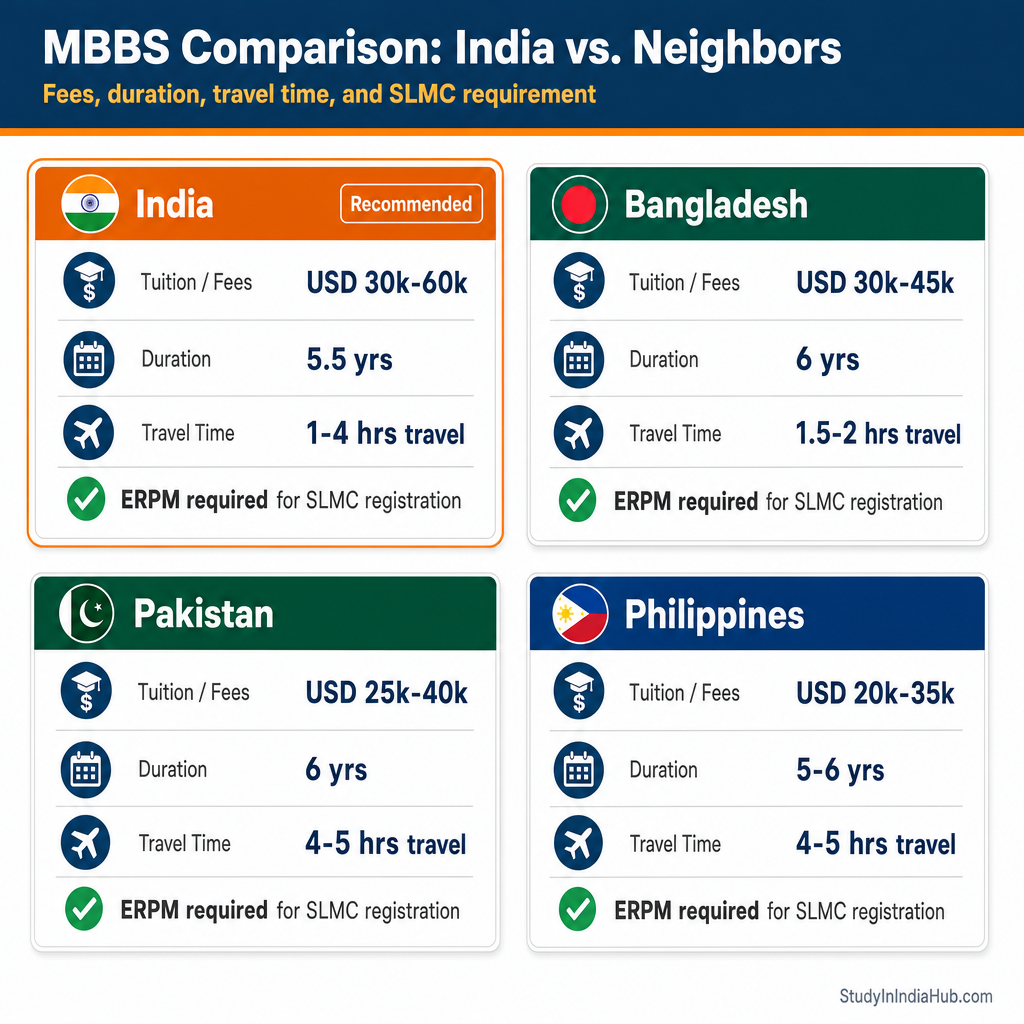
| Factor | India | Bangladesh | Pakistan | Philippines |
|---|---|---|---|---|
| Tuition (full course, approx.) | USD 30,000–60,000 | USD 30,000–45,000 | USD 25,000–40,000 | USD 20,000–35,000 |
| Course duration | 5.5 years (incl. internship) | 5 years + 1 year internship | 5 years + 1 year house job | MD: ~5–6 years (incl. pre-med) |
| Recognition (NMC/WHO listing) | Yes | Yes | Yes | Yes |
| Returning to Sri Lanka (ERPM/SLMC) | Must pass ERPM exam | Must pass ERPM exam | Must pass ERPM exam | Must pass ERPM exam |
| Travel from Sri Lanka | 1–4 hrs (very accessible) | 1.5–2 hrs | 4–5 hrs | 4–5 hrs |
| Medium of instruction | English | English | English | English |
In all four countries, a graduate returning must pass the ERPM exam prior to registering with the Sri Lanka Medical Council. Thus, the value of the degree relies on exam preparation, rather than solely on the outcome. Always verify the latest fees and ERPM regulations directly with the SLMC.NEET is mandatory. Since 2018, all international students are required to pass NEET to gain admission to Indian medical colleges (Study in India). It can't be bypassed at a private college. The National Testing Agency (NTA) establishes a yearly minimum qualifying percentile, commonly the 50th percentile for the General Category.Sign up via the Study in India portal. The SII Portal was introduced on 3 August 2023, operated by the MoE, MEA, and MHA. You apply, upload files, and arrange interviews here. Any postponement may result in penalties or legal action according to Indian law (Study in India). There is also funding available. The Nehru Memorial Scholarship Scheme supports undergraduate programs for Sri Lankan citizens (ICCR).
Eligibility and NEET Requirements
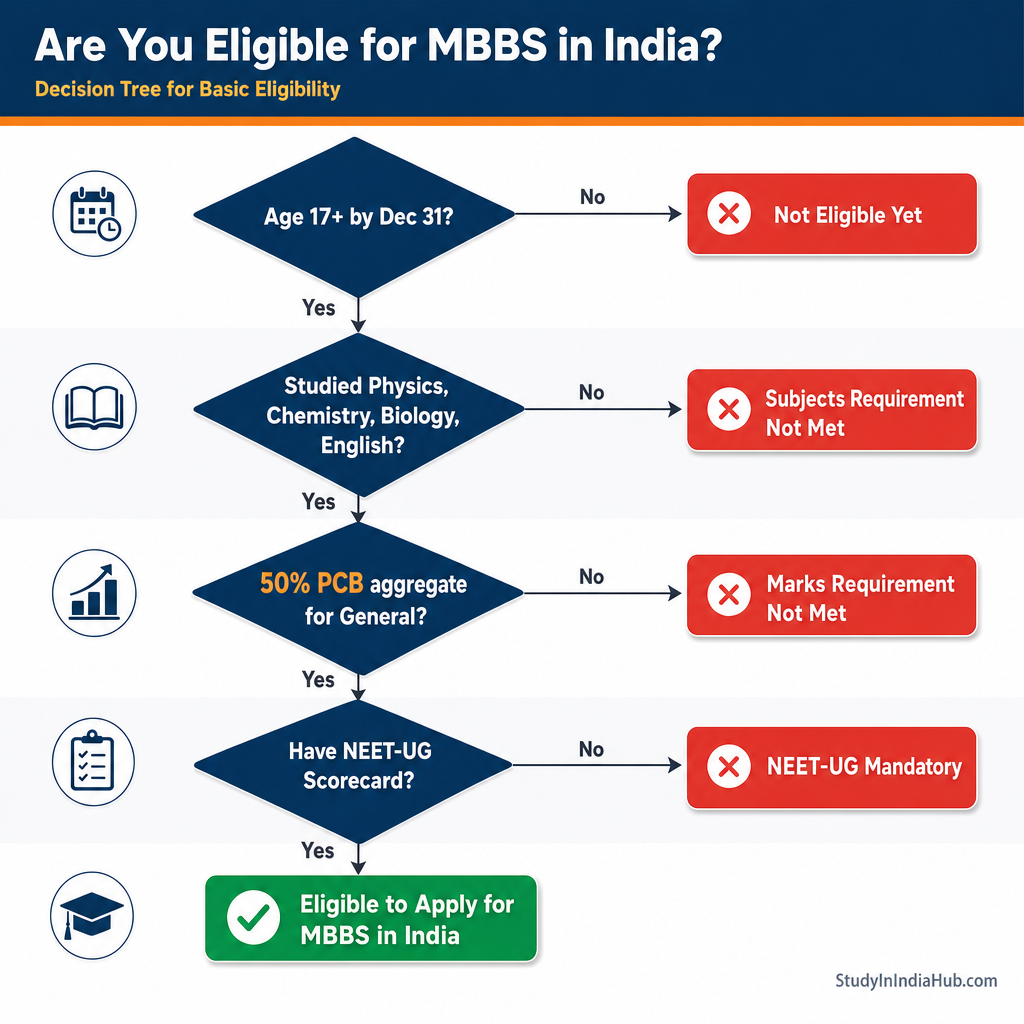
As a Sri Lankan citizen, you need to pass three requirements to enroll in an MBBS program in India: your marks from the 12th grade, your age, and your NEET-UG examination score. The figure displayed on a college website is seldom the score that secures you a spot.
Academic and Age Requirements
You need to have finished 10+2 with Physics, Chemistry, Biology, and English, and should be no younger than 17 years by December 31st of the admission year (dis.puchd.ac.in).
| Requirement | Detail |
|---|---|
| Minimum Age | 17 years by Dec 31st of the entry year |
| Subjects | Physics, Chemistry, Biology, English |
| Minimum PCB Score | 50% aggregate (General) / 40% (Reserved) |
| Mandatory Exam | NEET-UG |
| Foreign National Quota | Up to 15% of approved intake |
The official cutoff is 50% aggregate in PCB for the General Category. However, reputable colleges favor 60–70%+. Students with precisely 50% are rejected from their preferred choice. The reason isn't the cutoff; more qualified candidates just occupied the spots initially. The 40% reserved limit seldom pertains to foreign nationals unless a university designates those positions for international students.
NEET-UG: The Non-Negotiable Test
No university will accept you without a NEET scorecard. Your 12th grades do not alter that. Sign up online via the NTA website at neet.nta.ac.in:- The application period occurs annually, typically from December to February, for the assessment taking place in May.- Choose the "Non-Citizen" category and provide your passport number as identification.- The test is available in English, Hindi, and various Indian languages. Choose English at the time of registration.- Registration ends 4–6 weeks prior to the exam date. Skip it, and you forfeit an entire year.
What Score to Aim For
The qualifying threshold renders you "eligible." It doesn't secure you a place. Many reputable private colleges accept international students whose NEET scores fall within the 400–550 range out of 720. This depends on the college and the year. Review the previous cutoffs of your desired college. If international cutoffs are not published, reach out to admissions directly. International students are accepted beyond the sanctioned limit, up to 15% (Savitribai Phule Pune University). At SPPU, where more than 14,000 international students are enrolled, you primarily compete with other foreign applicants rather than the entire Indian merit list. Applying for the ICCR Fellowship? The A2A Portal launches 27 February–22 April 2026 and requires these benchmarks in advance (ICCR A2A Portal).
MBBS Fees for Sri Lankan Students (in LKR and INR)
The figure displayed on a university website is never the ultimate figure. This is the amount you will truly spend as a Sri Lankan student. We divide it into tuition, accommodation, and living expenses.
Tuition by College Type
Government colleges impose fees based on the foreign national quota, rather than the local rates. This establishes tuition at USD 5,000–USD 15,000 annually (approximately LKR 1.5 million–LKR 4.5 million, subject to exchange rates), significantly lower than private institutions. The cost varies based on the state, the college's rank, and available quota. A student from Colombo paid INR 3,50,000/year at a central university. Another paid INR 7,50,000 annually at a state university in Maharashtra.
| College type | Annual tuition (INR) | In LKR | Notes |
|---|---|---|---|
| Government | INR 3,50,000–7,50,000 | LKR 11–24 Lakhs | Best value under foreign national quota; seats limited, fees vary by category (Study in India) |
| Deemed | INR 8,00,000–18,00,000 | LKR 25–58 Lakhs | Mid-range; hostel and mess push first-year cost higher (Chanakya University) |
| Private | INR 15,00,000–30,00,000 | LKR 48–96 Lakhs | Where budgets break, especially metro colleges (Study in India) |
Hostel and On-Campus Living
Hostel fees are the expenses students tend to overlook. The majority of prominent universities state that hostel and mess charges range from INR 1,000–INR 3,000 per month, or INR 40,000–INR 2,50,000 per year (LKR 1.28 Lakhs–LKR 8 Lakhs) (Chanakya University). Chanakya University offers a triple bedroom for INR 1,42,000 (LKR 4.55 Lakhs) and a double bedroom for INR 1,84,000 (LKR 5.90 Lakhs) annually.
Monthly Living Costs by City
Daily expenses greatly vary based on the city. Budget tier refers to communal living and minimal dining outside. Comfortable refers to having a personal space and consistent dining at a restaurant.
| City | Budget (INR/LKR) | Moderate (INR/LKR) | Comfortable (INR/LKR) |
|---|---|---|---|
| Pune | ₹12,000 / ~48,500 | ₹20,000 / ~80,000 | ₹32,000 / ~1.28L |
| Delhi | ₹14,000 / ~56,500 | ₹23,000 / ~93,000 | ₹38,000 / ~1.53L |
| Bangalore | ₹15,000 / ~60,500 | ₹25,000 / ~1.01L | ₹42,000 / ~1.70L |
| Mumbai | ₹15,000 / ~60,500 | ₹25,000 / ~1.01L | ₹40,000 / ~1.62L |
Data from Numbeo: Pune, Delhi, Bangalore, Mumbai. Pune has the lowest cost among the four. If you're on a budget, consider Pune and Delhi initially.

A Real 5.5-Year Total
Here's the full math for a government-college route:
- Tuition Fee: INR 3,50,000 annually × 5.5 = INR 19,25,000 (LKR 61.6 Lakhs)- Hostel: INR 1,50,000/year × 5.5 = INR 8,25,000 (LKR 26.4 Lakhs)- Living (moderate): INR 20,000/month × 66 months = INR 13,20,000 (LKR 42.2 Lakhs)- Textbooks, lab sessions, tests: ~INR 2,00,000 (LKR 6.4 Lakhs)- Overall: INR 43,70,000 (~LKR 1.40 Crore / USD 13,200)A student at a private college would incur expenses of INR 1,00,00,000+ (LKR 3.2 Crore+) during that timeframe.
SAARC Quota and Scholarships
You can utilize SAARC quota advantages at certain central universities. For instance, Central University of Himachal Pradesh specifies distinct SAARC charges. These rates typically fall below the usual foreign national charge, so verify them prior to applying.
Degree Recognition and the Sri Lanka Medical Council
Tuition represents merely a part of the overall situation. The degree only becomes a license after an additional step at home. An Indian MBBS is acknowledged for practicing in Sri Lanka, but the degree by itself won’t allow you to be employed. Upon graduating and coming back, you take the Examination for Registration to Practice Medicine (ERPM), often referred to as the ACT 16 exam. It is managed by the Sri Lanka Medical Council (SLMC). This test is the barrier, not the diploma. Students who focus solely on admission and fees frequently complete 5.5 years of study, then encounter a setback before they can legally practice. The SLMC mandates that your Indian MBBS be obtained from a college accredited by the National Medical Commission. You subsequently complete the ERPM. Individuals who study for both Part A and Part B usually pass it more quickly. Sri Lankan graduates we have collaborated with claim that the ERPM is the actual obstacle, not the degree. Several require two to three tries to pass all sections. The interval between completing graduation and obtaining final registration typically extends to 12–18 months. The primary challenge is the variation in clinical case patterns and the strong emphasis on local public health. Their recommendation is clear: begin ERPM preparation while you are still in your internship year, rather than after you go back home. What we frequently observe: students believe that "approved in India" equates to "ready for Sri Lanka." It does not. The ERPM assesses your ability to utilize your knowledge in alignment with healthcare standards in Sri Lanka. Exact pass rates and exam formats are not disclosed, but students indicate that targeted preparation in the final year in India significantly impacts outcomes.
Why your college choice decides everything
Not all medical colleges in India hold the same value according to the SLMC. You need to register at an NMC-approved college. The National Medical Commission serves as the regulator in India, and the SLMC acknowledges degrees solely from colleges accredited by the NMC. Choose a university that is not included on the NMC list, and your qualification will not be recognized in Sri Lanka. You won't be permitted to take the ERPM. Students have gotten partway through an application only to discover that their college was not included. Confirm prior to making the initial payment:1. Verify that the college is recognized by NMC, directly consult the National Medical Commission's list.2. Verify that the SLMC acknowledges degrees from that specific institution.3. Inquire if the college accepts international students or those under the NRI quota.4. Retain all admission and fee documents from the start; inconsistent paperwork leads to registration holdups.5. Allocate funds for the ERPM/ACT 16 exam as an expense after graduation, as it is excluded from your tuition.
Plan the licensing step early
Upon graduating, you enroll with the SLMC, provide your degree and transcripts, and then take the ERPM. Deadlines and costs aren't made public. Reach out to the SLMC directly when you are prepared to submit your application. The greatest long-term financial error is allocating your entire budget to tuition while overlooking the return-and-exam period. If selected for a scholarship, maintain an additional 15–20% reserve for travel and healthcare expenses (immitalks.com). In brief: the degree will be recognized as a Sri Lankan license only if you consider NMC acknowledgment and the ERPM from the beginning.
Step-by-Step Admission and Application Process
The enrollment procedure progresses through distinct stages. The sequence is important. Skip a portal deadline in one instance, and it may prevent you from accessing the next.
Step 1: Register for NEET and take the exam
You need to sit for NEET before any college reviews your application. Sign up via the NTA website. You will require your passport number and an active email address. After obtaining your score, proceed. Avoid waiting for the formal certificate; numerous colleges recognize the scorecard accessed via the NTA portal.
Step 2: Pick your route and check the application windows
The three typical paths each utilize a distinct gateway. Submit to the incorrect one, and you lose weeks during peak season.
| Route | Portal | Key 2026–27 deadline |
|---|---|---|
| ICCR A2A Scholarship | a2ascholarships.iccr.gov.in | Opened 27 Feb, closes 22 Apr 2026 (cgichicago.gov.in) |
| AYUSH Scholarship | a2ascholarships.iccr.gov.in | Last date 15 May 2026 |
| Direct Admission / DASA | dasanit.org / studyinindia.gov.in | Varies by college |
Intakes in July and August may extend processing to 6–8 weeks or more because of the high volume. Submit your application early. Fail to meet the portal deadline, and your application won't make it to the university stage.
Step 3: Submit the application with complete documents
The typical reason for delays isn't talent. It's a scan that's absent or a form that hasn't been verified. Prepare:- NEET result card- Transcripts from 12th grade (including equivalency confirmation if required)- Copy of passport- Evidence of residency in Sri Lanka, along with a purpose statement if needed. Submit the complete collection prior to the deadline. Store the acknowledgment securely. Allocate an additional week for subsequent document requests.
Step 4: Wait for seat allocation, then act fast
Merit lists are released 2–4 weeks following the deadline. If chosen, you will receive an email confirming your seat with a 3–5 day period for acceptance. If you miss it, you lose your spot. For direct admission, the stated institutional fee is USD 5,400/year along with the NCHMCT fee of USD 600/year (nchm.gov.in).
Step 5: Pay fees and confirm enrollment
Grant recipients must verify if the scholarship organization pays the college directly prior to transferring funds. Upon payment, you get a confirmation of enrollment.
Student Visa, Travel and Settling In
Having your seat secured, the next step is obtaining the visa. The S-1 student visa for Sri Lankan citizens from India is a process based on documentation without an interview. Your document is submitted to the Indian High Commission located in Colombo. Authorization depends on the information you have given (High Commission of India, Colombo; Bureau of Immigration).
Keep these ready:
- Visa application form submitted (Indian Visa Online)2. Acceptance letter from your Indian college; without it, the application halts.3. Academic credentials, comprising original G. C. E. A/L grades and records (AIU Equivalence Division)4. Financial documentation, including bank statements, letters from sponsors, or scholarship grants that cover tuition and living expenses.5. Passport must be valid for a minimum of 6 months after your visit6. Accommodation verification (hostel reservation or lease agreement)Processing requires 5–7 business days. It may extend to 10 when documents require explanation. Visa fees and charges for VFS services differ by mission. Check the latest numbers on the official site before making a payment (Indian Visa Online). For a long-term degree, the visa is typically valid for a maximum of 5 years or the length of the course, whichever is shorter.
| Route | Duration | Typical Cost | Notes |
|---|---|---|---|
| Colombo → Mumbai | ~2.5 hrs | ~$120 | Most frequent; strong onward connections |
| Colombo → Bangalore | ~2 hrs | ~$130 | Closer to southern colleges |
| Colombo → Delhi | ~3.5 hrs | ~$140 | Northern colleges, AIIMS |
Book flights once you have visa approval, not prior. Advance reservations can lead to financial losses due to visa holdups. Should your visa last longer than 180 days, you are required to register with the FRRO within 14 days after arrival. This is required. Missing it leads to penalties and exit issues (Bureau of Immigration). Bring the original copies of your admission letter, passport, visa, and financial paperwork. Allocate ₹7,000–₹12,000/month for housing (NoBroker).
Tips and Key Considerations Before You Apply
The figure shown on the website is never the ultimate figure. Published statistics frequently overlook hostel deposits, NEET preparation resources, compulsory medical insurance, and the 2–3% fee incurred when converting LKR to INR. This is a common occurrence: families plan for tuition only, then are caught off guard halfway through the semester. Prepare for everything in advance and incorporate a 5–8% cushion for fluctuations in currency.Ensure NMC and SLMC approval before paying any seat booking fee. Check that your university appears on both the National Medical Commission (NMC) website and the Sri Lanka Medical Council (SLMC) sanctioned list. Avoid making assumptions. Reach out to the SLMC directly, mention your university's name, and request a written confirmation of their acknowledgment of MBBS degrees from that institution. Medical degrees encounter more rigorous equivalency standards compared to other fields.Steer clear of agent fraud. Apply exclusively via the official Study in India (SII) Portal prior to submitting your visa application. You can only seek immigration services once you receive a formal admission offer letter (Embassy of India, Vilnius). Engage exclusively with agents accredited by the Indian High Commission in Colombo, and confirm their qualifications with the embassy. "Assured entry" or "visa fast-tracks" are warning signs.Initiate your timeline immediately. Submit your Student Visa application at least 6 weeks prior to departure (University of Hyderabad). Certain portals recommend a 2-week minimum; however, a 6-week buffer is crucial for applicants from Sri Lanka.
Common Mistakes to Avoid
Neglecting the security deposit. Many colleges impose a security deposit ranging from ₹25,000 to ₹50,000 in addition to tuition fees. This surprises numerous families. Plan and allocate funds for it in advance. It's typically refundable when you check out, so ensure you keep your receipts secure.Assuming hostel lodging is assured. A college spot doesn't equate to a hostel mattress. Popular colleges quickly fill their rooms. Submit your hostel application as soon as your admission is finalized. Create a contingency plan for nearby private rental accommodations.Misjudging expenses in cities beyond Mumbai and Pune. Numerous students believe that smaller towns are consistently less expensive. That isn't always the case. Food, transportation, and housing costs differ greatly throughout India. Investigate the specific city where your college is located. Speak with existing Sri Lankan students in that location. Create a practical monthly budget prior to your arrival.Overlooking scholarship deadlines. Scholarships can significantly lighten the burden, but the deadlines are rigid. Numerous students miss opportunities because they submitted their applications late or were unaware of the available options. Begin your scholarship exploration prior to finalizing your enrollment. Record each deadline on a calendar. Organize your documents ahead of time.
Frequently Asked Questions
What is the number of questions in the NEET exam, and how should that influence my preparation?180 in total: 45 each for Physics and Chemistry, and 90 for Biology. Since Biology constitutes half of the exam, your preparation should represent that, rather than following a general strategy. Handling those 90 Biology questions frequently determines if you surpass the 50th percentile threshold for the "Others" group. Check the pattern with the most recent exam announcement prior to registering.Is it possible for a scholarship to cover the majority of the fee?Occasionally. Students only cover a significant portion when they align funding appropriately, correlating scholarship conditions with the actual fee structure. Verify the precise yearly tuition stated, for example, INR 25,000–500,000 for MBBS at the University of Mumbai.What amount of buffer should I maintain for unforeseen expenses?Maintain a 15–20% cushion for unexpected travel or medical expenses. The adjustment period in cities such as Mumbai or Pune includes fees that are not reflected in yearly tuition. The initial invoice is seldom the final one.How do Indian expenses stack up against other study locations?India operates at a much lower cost compared to Western alternatives, which require significant initial proof of financial resources.
| Destination | Living Cost Requirement | Upfront Tuition |
|---|---|---|
| India | approx. INR 1.5L–3L/year (Numbeo) | Varies by college |
| United Kingdom | £1,171–£1,529/month (UK Government) | Varies (UCAS) |
| Canada | CA$22,895/year + 1st-year tuition (Statistics Canada) | Varies |
| Ireland | Varies | €6,000 mandatory upfront (IDP) |
If a quote combines everything, inquire if it's tuition-only or comprehensive.Do genuinely affordable non-medical alternatives exist?Certainly! Yes. Tuition fees for international students at Delhi University for a BA degree range from INR 4,800–21,000/year (DU Foreign Students Registry), frequently lower than the airfare from Colombo to Delhi.How much do international students pay for BTech and MBA fees?
| Program | Mumbai University | SPPU |
|---|---|---|
| BTech | INR 60,000–770,000 (Shiksha) | INR 40,000–180,000 (Shiksha) |
| MBA | INR 42,600–840,000 (Shiksha) | INR 50,000–250,000 (Shiksha) |
These ranges fluctuate between government-supported and self-funded seats. Evaluate by department, not merely by institution. Verify if the "International Student Fee" is a fixed multiplier of the local fee, a typical structure in state universities.What if the fee information on a site appears confusing?Reach out to the international student office directly and request a detailed written explanation. The reported figure is seldom the total expense.
About the Author
Arun Menon dedicated three years at ICCR overseeing scholarship programs before he became part of StudyInIndiaHub.com to assist international students with tuition fees, living expenses, and funding opportunities. He simplifies intricate fee structures into straightforward comparisons and is aware of the exact costs that universities often leave unmentioned.
How We Researched This Article
Every article is verified against primary sources and evaluated by education experts who have firsthand experience in international student admissions. We gather our information from official university websites, NAAC/NIRF databases, government visa websites, Numbeo cost-of-living statistics, and direct communication with university international student offices. Daily updates on exchange rates. Weekly updated living expenses. University information assessed every three months. Think about a typical trip we have monitored. After passing NEET, a student obtained an MBBS seat at a recognized university in Tamil Nadu. Overall tuition and living expenses averaged approximately ₹65–75 lakh throughout the 5.5-year course. The course concluded on the usual schedule, succeeded by a six-month rotational internship. The graduate subsequently went home and took the ERPM (previously Act 16) examination mandated by the Sri Lanka Medical Council. Clearing it enabled complete registration to operate. Keep in mind that obtaining ERPM clearance frequently requires multiple attempts, so allocate additional months for preparation. Seats in the foreign national quota are not assigned solely based on NEET rank. Sri Lankan candidates must still possess a valid NEET-UG qualifying score. However, the distribution of seats in the NRI/foreign category is largely influenced by document verification, payment deadlines, and the way each institution divides its restricted foreign quota seats. Students have been observed to clear NEET ahead of others, yet postpone submitting their eligibility certificates or financial documents, resulting in missed opportunities at preferred colleges to those who score slower but are better prepared.
Sources
- Study in India
- Study in India
- ICCR
- dis.puchd.ac.in
- neet.nta.ac.in
- Savitribai Phule Pune University
- ICCR A2A Portal
- Study in India Portal
- Chanakya University
- Numbeo — Bangalore
- Numbeo — Pune
- Numbeo — Delhi
- Numbeo — Mumbai
- Numbeo — India
- AIU Equivalence Division
- NAAC Accreditation Results
- Central University of Himachal Pradesh
- immitalks.com
- a2ascholarships.iccr.gov.in
- cgichicago.gov.in
- dasanit.org
- nchm.gov.in
- High Commission of India, Colombo
- Bureau of Immigration
- Indian Visa Online
- Indian Visa Online — fees
- NoBroker
- Embassy of India, Vilnius
- University of Hyderabad
- Edvoy
- University of Mumbai
- UK Government — Student Visa
- UCAS
- Statistics Canada
- IDP
- DU Foreign Students Registry
- Shiksha