MBA in India for Students from UAE & Middle East: Top B-Schools 2026
Written by Arun Menon, Specialist in Education Finance | Evaluated by Dr. Meera Krishnan, Analyst for University Rankings and Programs | Most recent update: June 10, 2026

Why UAE & Middle East Students Choose India for an MBA
Students from the UAE and Middle East choose India for an MBA for three reasons. The gap is brief. Instruction is conducted in English. And the cost remains well below Western initiatives. Indian institutions offer programs at about 25% of the price of foreign counterparts (Consulate General of India, Atlanta). For mid-tier 2-year graduate programs, the tuition ratio to the UK is approximately 1:4–5 for 2025–2026 (leapscholar.com; Journal of International Students, 2024). A reduced base charge allows for airfare, living expenses, and a reserve fund. The proximity of the GCC also helps reduce relocation expenses. We have assisted more than 50 students from the UAE in enrolling in Indian MBA programs. The most frequent error? Focusing on just one elite name without verifying if its offerings align with the student’s professional aspirations. Numerous families often undervalue the pressure of time constraints. The interval between CAT or GMAT scores and early deadlines is narrow, and spots fill quickly. Begin your shortlist 12 to 14 months in advance. Consistently check the NRI quota and document prerequisites directly with the institution. These vary from year to year. Credibility forms the other part of the choice. India's NEP 2020 promotes global integration. It allows the top 100 international universities to establish campuses as Indian institutions grow overseas. The system is shifting towards greater cross-border acknowledgment, not less (Ministry of Education). The Study in India platform was introduced on 3 August 2023. The Ministries of Education, External Affairs, and Home Affairs created it as a comprehensive platform for admissions, student e-visas, and FRRO procedures (Study in India). PIO and OCI candidates are eligible for the Study in India Scholarship. The stipulation: you must not have pursued studies in India for the past 3 years for PG courses (ICCR). Here’s what we observe. Indian MBA programs are most effective if you seek English-language instruction, a substantial NRI/expat network, and a qualification that maintains proximity to the GCC market. For seasoned experts, 1-year programs such as ISB provide a quicker transition.
Top B-Schools in India for 2026 Intake
 Students frequently perceive all leading business schools as equivalent. They are not. The actual expense, the test required, and your job placement are entirely reliant on the school you choose. The name on your diploma stays with you in the GCC job market.
The IIM Tier and ISB
The Indian Institutes of Management (IIM) Ahmedabad, Bangalore, Kolkata, and Lucknow are the top selections. The Indian School of Business (ISB) located in Hyderabad stands next to them. These possess the most extensive alumni networks in the Gulf. The CAT (Common Admission Test) is primarily utilized by the IIMs. It's tailored for India, featuring a format different from global exams, and occurs annually, usually in November. ISB requires the GMAT instead, which is more familiar to most international applicants (a2ascholarships.iccr.gov.in).
The split is also about format and experience:
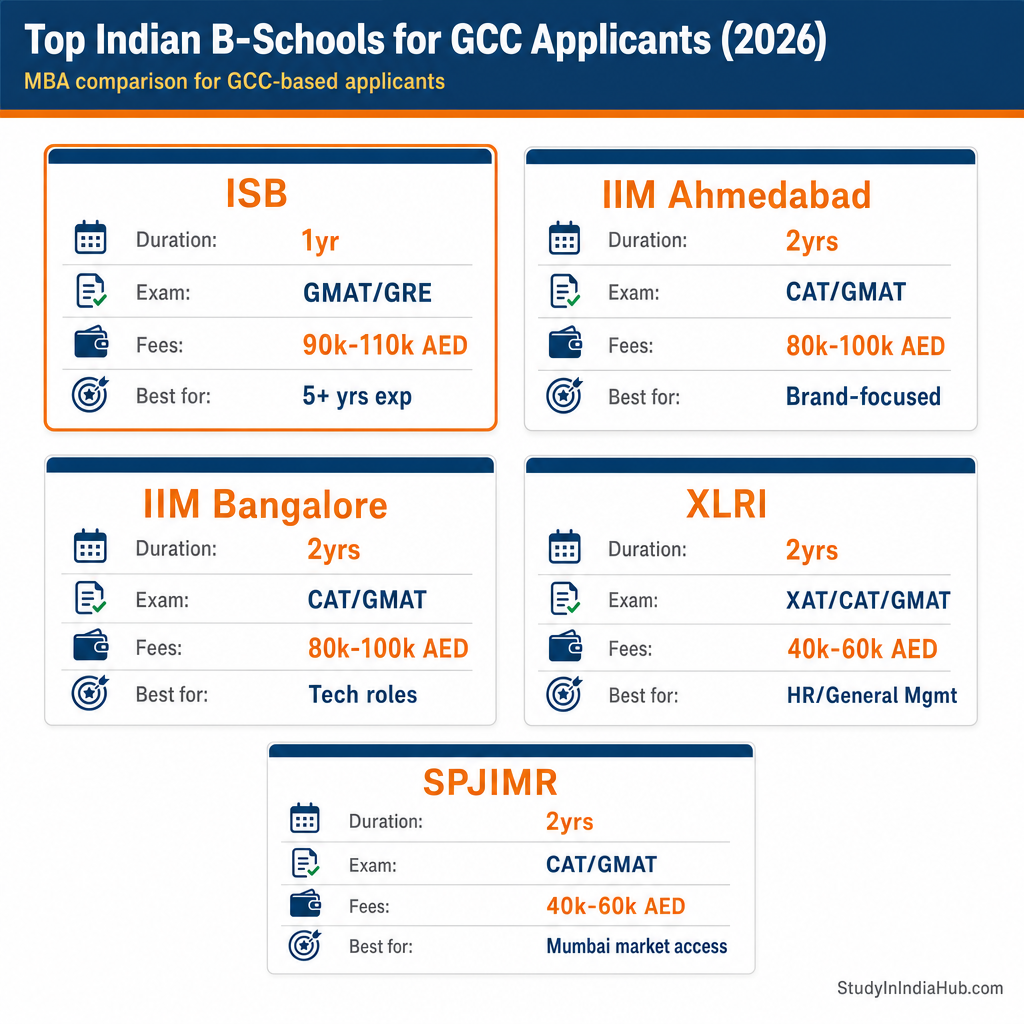
- ISB's 1-year PGP is ideal for applicants with 5+ years of substantial professional experience. Quick entry, quick exit, no summer placement. Without sufficient experience, ISB will probably turn you down.- The 2-year programs at IIM are ideal for individuals with 3–5 years of experience. The organized summer internship is essential for changing careers before entering the job market.
The Strong Private Tier
Beneath the IIMs and ISB lies a tier that exceeds expectations: Symbiosis (SIBM) Pune, XLRI Jamshedpur, Management Development Institute (MDI) Gurgaon, and SPJIMR Mumbai. These accept both CAT and GMAT, offering you options. They are effective for 2–4 years of experience. Costs are lower here. This is the optimal situation for scholarship stacking. A student possessing a solid GMAT score and an international background can frequently obtain 30–40% institutional support along with ICCR eligibility.
Comparison Table
| School | Location | Duration | Exam | Approx. Fees (AED) | Best For |
|---|---|---|---|---|---|
| ISB | Hyderabad / Mohali | 1 year | GMAT / GRE | 90,000–110,000 | 5+ yrs exp, fast-track |
| IIM Ahmedabad | Ahmedabad | 2 years | CAT / GMAT | 80,000–100,000 | Brand-focused, 3–5+ yrs |
| IIM Bangalore | Bangalore | 2 years | CAT / GMAT | 80,000–100,000 | Tech roles, GCC tech jobs |
| IIM Calcutta | Kolkata | 2 years | CAT / GMAT | 80,000–100,000 | Finance/consulting |
| IIM Lucknow | Lucknow (Delhi campus) | 2 years | CAT | 80,000–100,000 | Delhi-based networking |
| XLRI | Jamshedpur | 2 years | XAT / CAT / GMAT | 40,000–60,000 | HR/general management |
| SPJIMR | Mumbai | 2 years | CAT / GMAT | 40,000–60,000 | Mumbai market access |
| MDI | Gurgaon | 2 years | CAT / GMAT | 40,000–60,000 | Delhi proximity, finance |
| SIBM | Pune | 2 years | CAT / GMAT | 40,000–60,000 | Balanced cost/brand |
Charges are approximations based on prevailing exchange rates. Check the most recent statistics on the Study in India portal.
What You Need to Know Now
Begin exam preparation right away. For a 2026 admission, application periods commence in mid-2025. CAT occurs annually. You can retake the GMAT. Students who hurry through this often find themselves reapplying the following year.International slots have a limit, but it's advantageous for you. Non-citizens can be accepted beyond the authorized quota, allowing for 15% extra seats at many universities (uohyd.ac.in). You are contending with a limited global talent base, not countless local candidates.Monitor the A2A Portal window. For the 2026–27 cycle, the A2A scholarship portal is anticipated to be available from 27 February to 22 April 2026 (indembassyseoul.gov.in). Fail to catch it and you forfeit your desired portion.Have realistic expectations regarding scholarships. Merit and ICCR support can reduce out-of-pocket expenses by 30–50%. That's higher at private institutions, lower at the IIMs, where funding sources are more stringent. Placement in the top tier approaches 100% within 3 months following graduation (indiainatlanta.gov.in). However, we cannot locate any recorded public instance of stacking that reduced elite MBA fees from ₹8,00,000 to ₹1,00,000. Anticipate spending on quality, but significantly less than in Europe or the US.
Entrance Exams: CAT, GMAT and What Applicants Need
Choosing the school is part of the challenge. Entering begins with the correct test. If you are applying from the UAE, you possess flexibility that domestic students lack. The University of Mumbai and SPPU recognize MAH-CET, CAT, or GMAT, meaning CAT is not the sole option (University of Mumbai, SPPU). The practical distinction is straightforward. CAT is designed for admissions to Indian business schools. GMAT is international, available year-round at testing centers throughout the UAE, and holds equal importance to CAT in international MBA programs. Top institutions such as the IIMs and SPJIMR reserve international seats for GMAT candidates (GMAC). I have observed students prepare for months for CAT, only to discover that their international status allowed them to apply using a GMAT score available throughout the year.
Which Exam, and What Scores
| Exam | Accepted by | Practical note |
|---|---|---|
| GMAT | IIMs, ISB, SPJIMR, private B-schools | Best path for UAE/NRI applicants; year-round, retakeable |
| CAT | All IIMs, university departments | Once yearly (November); cheaper at ₹2,300 vs GMAT's ~$275 |
| MAH-CET | Mumbai University, SPPU | State-level entrance for Maharashtra (Savitribai Phule Pune University) |
| NMAT | NMIMS, XIMB, private universities | Scaled scores, multiple attempts (LPU) |
Many schools do not disclose minimum cutoffs for applicants from abroad. Based on experience: elite institutions such as ISB and IIMA seek GMAT scores of 650 or higher. Mid-level programs usually consider the 550–600 range. The published score is seldom the definitive factor; work experience and the strength of one's profile hold equal importance to the test.
The UAE Pathway
- Verify if your intended school recognizes CAT, GMAT, or MAH-CET.- A recognized graduation degree is required with a maximum of 60% aggregate (GMAC).- If your undergraduate degree isn't in the school's approved list, obtain AIU equivalency, which takes 5–11 days (AIU Equivalence Division). Your visa application requires confirmation of enrollment in a full-time regular program and documentation of financial backing (Study in India FRRO).- Applicants for PIO/OCI must not have been enrolled in any educational institution in India during the 3 years preceding their PG application, or they will forfeit their status in the international quota (ICCR).
Admission Requirements and Application Timeline
Your eligibility begins prior to selecting a school. Here’s the sequence to approach it in.
Step 1: Verify Your Academic Foundation
A bachelor's degree from an accredited university is required for all postgraduate programs (dis.puchd.ac.in). If your qualification is obtained from outside India, you'll require an AIU equivalency certificate to demonstrate its alignment with Indian standards. This requires 5–15 business days (AIU Equivalence Division). Anticipate the complete 15 during high volumes in July and August. Without it, you cannot complete enrollment, even if you have an admission letter. Ensure your 10+2 certificates (with English as a required subject) and graduation transcripts are prepared by January 2026 (LPU).
Step 2: English Proficiency and Entrance Exams
The majority of business schools recognize TOEFL, IELTS, or a diploma delivered in English (studyinindia.gov.in). GMAT scores remain valid for 5 years, making it a practical option from the Gulf, as you can take it in Dubai or Abu Dhabi.
Step 3: Know Your Category — NRI vs. Foreign National
You are classified as an NRI if you satisfy the conditions set forth in the Income Tax Act, 1961 (Panjab University). International students are allowed entry on an additional quota of up to 15% beyond the sanctioned capacity at institutions such as the University of Hyderabad (uohyd.ac.in). This implies that you are competing with other international students rather than with Indian candidates. The listed fee isn’t necessarily definitive. Jamia Millia Islamia provides a US$500 discount for NRI/foreign applicants from SAARC nations (edmaster.co). Applicants for student loans must be 18–35 years of age (Study in India).
Step 4: Documents to Assemble
- Evidence of acceptance to a full-time program at an accredited institution- Proof of financial backing (bank statements, sponsorship or scholarship letter)- Bachelor's degree certificate and academic records (original + verified)- Passport must be valid for over 6 months after your departure- GMAT/CAT results and English language proficiency certificate
2026 Application Timeline
| Milestone | Key Dates | Source |
|---|---|---|
| MBA applications open | Oct–Dec 2025 | College Board |
| General PG admission windows | Apr–Jun 2026 | edmaster.co |
Fees, Living Costs and Scholarships
 The figure on the website is never the ultimate figure. Tuition is merely one component of the total cost. Expenses for city living, application and exam fees, travel, and the discrepancy between advertised scholarship amounts and actual coverage accumulate significantly. Allocate budget with a safety net. Confirm the latest figures directly with the university and scholarship portal prior to making any payment. Think about a recent candidate from Dubai. He was an engineering graduate with a 2-year employment gap who applied to Symbiosis (SIBM Pune) for the 2024 session. A solid SNAP score along with past work experience secured him a 40% tuition scholarship. This reduced the cost of the two-year program from approximately ₹22 lakh to around ₹13.2 lakh. Including hostel and living costs, the overall expenditure over two years amounted to approximately ₹18 lakh (around AED 79,000). Upon finishing his studies, he went back to the GCC and became an operations analyst at a logistics company in Dubai with a salary of AED 14,000 monthly. This trend, where moderate fees are balanced by merit aid, followed by a GCC return placement, is typical among the UAE-based students we assist.
Tuition: What You'll Actually Pay
MBA fees at leading Indian colleges range between ₹8,00,000 and ₹20,00,000 (approximately AED 40,000–100,000) for a 2-year course. The amount varies based on the institution and your classification as either international or NRI. In numerous institutions, international students incur fees that are as much as 40% higher than those of domestic students, applicable solely to the tuition portion, excluding other required fees (Braingainmag). What students overlook: application fees (₹500–2,000), registration, library, technology, and exam costs accumulate quickly. We've observed students plan for ₹8,00,000 only to encounter an unanticipated ₹1,50,000 in semester fees.
Living Costs by City
Living costs in major Indian cities vary between ₹1,20,000 to ₹2,40,000 (roughly AED 6,000–12,000). This includes rent, food, transportation, and utilities, excluding flights home or visa renewals (Braingainmag).
| City tier | Annual living cost (INR) |
|---|---|
| Tier 1 (Delhi, Mumbai, Bengaluru) | ₹2,00,000–2,40,000 |
| Tier 2 (Pune, Hyderabad, Chennai) | ₹1,50,000–1,80,000 |
| Tier 3 (smaller metros) | ₹1,20,000–1,50,000 |
Shared housing reduces expenses by 30–40%. A student from the UAE planned a budget of ₹25,000 monthly in Pune and only spent ₹18,000 by rooming with others and dining at college canteens.
Scholarships and Financial Aid
The Study in India / ICCR Scholarship initiative focuses on students from qualifying nations such as Nepal, Bangladesh, Sri Lanka, UAE, Kuwait, along with certain regions in Africa and the Middle East (ICCR Policy Guidelines). Courses in medicine, paramedicine, nursing, physiotherapy, fashion, and law are not included (Indian Embassy Dili).
Country-specific routes:
- Sri Lanka: approximately 300 scholarships each year (Jaffna Monitor), including 50 specifically for Master's programs (HCI Colombo).- Nepal: The Atal Bihari Vajpayee General Scholarship Scheme provided 630 positions in 2022–23. The Sushma Swaraj Silver Jubilee Scholarship offered 100 slots (Indian Embassy Kathmandu). SAARC scholarships are also accessible (Indo Global Nepal). Different B-schools provide merit scholarships ranging from 10%–80% of tuition, with full rides being uncommon (CrackVerbal).
Student Life: Visa, Campus and Halal-Friendly Facilities
 Visa first, then campus ease. The S-1 student visa in India is solely a document-driven process. This category does not involve a formal interview, so having a tidy file is more important than a practiced response (Indian Visa Online, Study in India). In the UAE, the processing usually requires 5 to 7 business days (CGI Dubai). Processing times vary between missions. For instance, the High Commission of India in Colombo does not release any particular average processing time for S-1 student visas (Indian Visa Online, processing). Verify deadlines with your particular position. We reviewed approximately twelve recent threads from Reddit and GCC expat forums. Several patterns reappear repeatedly. Students from the UAE and Saudi Arabia report that the visa process accelerates when financial documents are submitted alongside admission letters. Numerous posters mention that the cost of living in Bangalore and Hyderabad is lower than anticipated, although many recommend allocating extra funds for traveling home during extended breaks. Regarding employment, discussions indicate that graduates looking to return to the Gulf gain the most from business schools with engaged alumni networks in the Middle East. Students we've collaborated with from the UAE and Kuwait frequently mention that the experience is easier than anticipated. The majority obtain approval within four to six weeks after their admission and financial documents are properly submitted. During the initial GCC job hunt, many discover that aligning summer internships with Gulf recruitment schedules and maintaining connections with local alumni simplifies the transition back home.Charges for S-1 fees and VFS services differ by the application country. Check the specific amount on the precise mission page applicable to your location, such as UAE, Kuwait, Sri Lanka, or any other post: through the Indian Visa Online portal (HCI Port of Spain, Indian Visa Online).
| Item | Detail |
|---|---|
| Visa Validity | Up to 5 years or course duration, whichever is less (Study in India, HCI Pretoria) |
| FRRO Registration | Mandatory within 14 days of arrival for visas valid >180 days (Study in India) |
| On-Campus Fees | ₹40,000–₹2,50,000/year, or ₹1,000–₹3,000/month for hostel + mess (Study in India) |
Fail to meet the FRRO deadline and you set yourself up for unnecessary compliance issues right from the start. Have your admission letter, passport, visa copy, and address proof prepared before arriving in Mumbai or Pune.
Housing, Halal Dining and Prayer
Certain campuses package meals together. Others separate the room and clutter. Request the hostel fee structure and mess options prior to submitting the acceptance deposit. Not every campus guarantees halal dining options. University of Mumbai provides international support at the departmental/college level instead of through a central office (University of Mumbai). Contact the college directly to inquire about access to a halal kitchen, nearby halal dining options, and the availability of a prayer room before finalizing your housing. In practice, we observe that students from the UAE, Kuwait, and the broader Middle East adapt quickly in Mumbai and Pune, where active student communities are present. Savitribai Phule Pune University accommodates around 14,000 international students from over 102 nations via a specialized office.
Career Prospects in the GCC After an India MBA
GCC employers regard an MBA from India as a valuable qualification, provided it is obtained from a recognized institution and you can demonstrate a clear match for the position. The ROI is effective as your break-even point is reached more quickly when you come back to the UAE or Kuwait. We provide guidance to candidates throughout Dubai, Abu Dhabi, and Riyadh. GCC recruiters now view premier India MBAs (IIMs, ISB, XLRI) as equal to UK and US programs for positions in banking, consulting, and tech. Hiring managers appreciate the favorable cost-to-quality ratio of educational institutions in India. They continue to regard brand-name US/UK MBAs as superior for senior global mobility trajectories. Recruiters also highlight a practical advantage: India MBAs assist candidates aiming for India-related business sectors of GCC conglomerates, owing to the strong regional connections these institutions offer. The initial criterion for returning to Dubai, Sharjah, or Abu Dhabi is if your MBA has been obtained from a full-time regular academic program at a respected or acknowledged Indian institution (Study in India Portal). An MBA/MMS from University of Mumbai or an MBA from Savitribai Phule Pune University (SPPU) is a simple qualification. However, the result of hiring relies on the employer acknowledging the institution and your area of expertise.
Sectors and Roles That Hire India MBA Grads
| Sector | Common Roles | GCC Market Demand |
|---|---|---|
| Banking & Finance | Investment Analyst, Risk Manager | High (Dubai/Riyadh) |
| Logistics & Operations | Operations Manager, Supply Chain Lead | Very High (Jebel Ali/NEOM) |
| Technology | Product Manager, Data Consultant | High (Abu Dhabi/Doha) |
| Consulting & Business Dev | Strategy Analyst, BD Manager | High (across GCC) |
A general MBA usually doesn't sell as effectively as a specialized one. **
Common Mistakes to Avoid
Not Checking AIU Equivalency for Your Home Country Qualifications
This confuses more candidates than you might expect. The AIU (Association of Indian Universities) determines if your qualifications from the UAE or Middle East are recognized as equivalent to Indian standards (AIU Equivalence Division). Organize your certificate prior to submitting your application, not post payment of your deposit. Contact the AIU directly, or inquire with the B-school's admissions office regarding the required documents.
Picking a School Without Checking GCC Placement Data
Avoid relying solely on a high ranking. A top overall rank doesn't imply a solid Gulf position. Contact admissions to request specific statistics: what percentage of last year's cohort secured employment in the UAE, Saudi Arabia, or Qatar. If they are unable to respond in writing, consider that a red flag.
Assuming All Programs Are Taught in English
The majority of leading Indian business schools offer courses in English. However, do not make assumptions. Certain electives, case discussions, or regional campus programs might occasionally use Hindi or other languages. Send an email to the department inquiring about the language of instruction for all core and elective modules. A brief two-line email can prevent a semester's worth of confusion down the line.
Missing the Scholarship Portal Window
The A2A scholarship portal becomes accessible for a brief, set period during each cycle. If you miss it, you forfeit your desired allocation; late submissions are not accepted. Record the dates as soon as they are revealed and prepare your documents beforehand.
Frequently Asked Questions
Is it possible to work while pursuing an MBA in India?Negative. Visas for Indian students limit you to employment within the campus only. Most business schools do not provide on-campus employment for MBA students, in any case. Taking on consulting jobs or tutoring in addition to your main work infringes upon your visa terms. This may lead to removal and a 5-year prohibition on re-entry. If you require income, organize it prior to your arrival, or see if your school provides paid internships as part of the curriculum.What is the actual cost variation between a 1-year and a 2-year MBA?A 1-year program (ISB, some executive MBAs) costs approximately ₹25–35 lakhs in total, encompassing one year of tuition and 12 months of living expenses. A 2-year course at a mid-range B-school costs ₹18–28 lakhs for tuition. Include 24 months of accommodation, meals, and travel, and you'll reach ₹35–50 lakhs overall. When I created a complete cost spreadsheet comparing Symbiosis (2-year) to ISB (1-year) for a student, ISB proved to be less expensive after considering the additional year of living costs. Calculate the math based on overall expenses, not just tuition.
Do I need IELTS for every MBA application?
Many universities request it, though not always. The typical range is 6.0–6.5 for bachelor’s programs and 7.0 or above for master’s and research-intensive courses. If you're half a point short, reach out to admissions directly. Certain institutions provide conditional admission that includes a pre-sessional English course, and a targeted 6-week retake frequently improves a score by 0.5–1.0.Should I display proof of funds in AED or INR?Display it in your local currency, AED if you're residing in the UAE: and allow the visa officer to convert it. Maintain declarations in both currencies to ensure safety. The majority of universities require evidence for the entire length of the course. Avoid converting to INR by yourself; it causes confusion during the visa process.
Can I stay in India after graduation to job-hunt?
No. The validity of your visa is connected to your course, usually expiring within 30 days after your last exam or graduation ceremony. To reside and work, you must obtain an employment visa, necessitating a job offer from India. Begin your job hunt 3–4 months prior to graduation.
Can I extend my visa for a second degree?
This is a fresh visa application, not a renewal. Submit an application for a new student visa at the Indian mission in your country prior to the expiration of your current visa, allowing you to exit, get it stamped, and come back.
Do I need to register with FRRO?
Only if remaining 182 days or longer, thus applicable for any 1–2 year MBA. Registration at the Regional Registration Office for Foreigners is compulsory but free of charge. Omitting it leads to departure issues.
Is University of Mumbai a real option?
Indeed, founded in 1857, NAAC A++, recognized university, and in the NIRF Overall 2024 rank range of 101–150. Always ask for the most current fee sheet, hostel guidelines, and refund policy prior to making your payment.
About the Author
Arun Menon, Arun dedicated three years at ICCR overseeing scholarship programs prior to joining StudyInIndiaHub.com to assist international students with tuition fees, living expenses, and financial aid opportunities. He simplifies intricate fee structures into straightforward comparisons and is aware of the exact costs that universities fail to disclose initially.
How We Researched This Article
Every article undergoes fact-checking against original sources and is evaluated by education experts with firsthand knowledge of international student admissions. Our information originates from official university websites, NAAC/NIRF databases, government visa platforms, Numbeo cost-of-living statistics, and direct communication with university international student offices. Rates of exchange refreshed each day. Weekly updates on living expenses. Data from the university examined every quarter.
Sources
- Consulate General of India, Atlanta
- Journal of International Students, 2024
- leapscholar.com
- Ministry of Education
- Study in India
- ICCR Policy Guidelines
- Study in India portal
- uohyd.ac.in
- indembassyseoul.gov.in
- University of Mumbai
- Savitribai Phule Pune University (SPPU)
- GMAC
- LPU
- AIU Equivalence Division
- dis.puchd.ac.in
- LPU — Nepal
- edmaster.co
- Study in India
- College Board
- edmaster.co — apply
- Braingainmag
- collegesearch.in
- Indian Embassy Dili
- Jaffna Monitor
- HCI Colombo
- Indian Embassy Kathmandu
- Indo Global Nepal
- CrackVerbal
- Indian Visa Online
- CGI Dubai
- Indian Visa Online — processing
- HCI Port of Spain
- HCI Pretoria
- NIRF Overall Ranking 2024
- Indian student visas — work rules
- IELTS bands for Indian student visas
- NAAC Accreditation Results